Mid-Range Systems Concepts and drawing the Boundaries of High Tech
Systems development is closely associated with the production of technological artifacts, in particular with computer based high tech products and projects. Systems development is presented as an engineering design method (Gregory and Richard L., 1963, Brooks Jr., 1995). Indeed engineering design has become doubly system-like as systems development concepts were applied both to the design of high tech products and to the organization of the work of high tech production itself. The very idea of systems and systems thinking is so pervasive as to become an intuitive concept. A system can be considered as any assemblage or set of objects (concepts, things, distinctions) connected in some orderly or meaningful arrangement.
“The systems approach to problems focuses on systems taken as a whole because there are some properties of systems that can only be treated from a holistic point of view.” (Ackoff, 1971)Like any powerful concept the idea of system is flexible and adaptable. The questions posed by systems thinking are what elements to include, how to relate them, and where to draw the outline of the ‘whole.’ The boundary (if any) becomes crucial, what is considered inside or outside, is the boundary itself another element or does the idea of boundaries or interfaces even make sense?
THE PROBLEM OF HIGH-TECH SYSTEMS
Why does it take so long to get software ready?The same questions have been raised at every point in the history of computing and are still being raised today. Furthermore they are as relevant now as they were then. However, in 2003, Nicholas Carr famously declared that IT doesn’t matter anymore (Carr, 2003). He suggested that organisations should spend less on IT, copy other organisations’ technology infrastructure rather than generate innovations, and focus on operational improvements rather than creating competitive advantage through radical innovative development. So, if IT doesn’t matter anymore, why is there an on-going problem managing high tech products and IT governance?
Why are development costs so high?
Why can’t we find all the errors before we give the software to our customers?
Why do we continue to have difficulty in measuring progress as software is being developed?
Adapted (Pressman, 2000).
We observe a continuous current of media, practitioner, and research literature reporting the failures of large-scale system implementations (Ruey-Lin, 2006, Krigsman, 2010, Lyytinen and Robey, 1999, Currie and Willcocks, 1998, Keil and Montealegre, 2000). Much of the reportage and research concludes that IT use, production, delivery and management are brittle. IT is incredibly sensitive to situation, context and human factors (Suchman, 1987) and, evidently, as IT shifts across the product/service spectrum from stand-alone product to service rich high tech systems, outcomes become more costly and chaotic (Brooks Jr., 1987).
IT systems have become more complex and therefore more difficult to manage. Project planning and governance is particularly challenging when the subject matter is highly virtualised and intangible. IT systems become organisationally systemic even as system knowledge and skills become more specialised and rare. Various actor strategies and organisational structures may disconnect or invert necessary links between knowledge, responsibility and power.First some definitions. IT (Information Technology), ICT (Information Communications Technology), and High Tech are broad terms and difficult to pin down. For the purposes of these readings we can consider them to be products and services utilising microprocessors and the related objects they entail. High tech systems utilise hardware (electronics) and software (programs), often in the form of computing devices, computers, networks and Internets, although some high tech systems are less evident or may now be considered old tech, e.g. wrist watches.
Adapted (Avison et al., 2006).
The organization of the high tech development and production is naturally important but equally significant is how the development process is used to understand, formulate and resolve the real world needs or problems addressed by high tech products. Product systems are created against a backdrop of our prior assumptions and understanding of what systems actually are. Our understanding of what constitutes a system needs therefore to be clarified, so, what in fact are ‘systems’?
The idea of systems and ‘systems thinking’ is so prevalent as to have become an intuitive concept or perspective of any aspect in the world. The word system is now linked with the environment, ecology, markets, engineering, society, and politics. The OED defines a system as;
“a set or assemblage of things connected, associated, or interdependent, so as to form a complex unity.” (OED, 2010)The system concept is used for operations research to create models; mapping representations of disparate phenomena and functions, presenting them as an organizational whole. In the most general sense the system concept is applied when a complex phenomena is perceived to
“…display the character of being organized.”The appearance of organization, of being organized, is assumed to arise out of interdependencies between underlying processes or other related phenomena. One of the challenges to studying and interacting in complex relational environments is the very act of defining the system.
(Emery and Trist, 1965)
Systems can therefore be understood as descriptions that limit the extent of an enquiry. A system is constructed by description. A system is a more or less exhaustive statement of more or less arbitrary boundaries, inputs, outputs, interactions, behaviour, performance, relationship, of abstract and concrete objects.
At its most general the very idea of a system helps us to organize ideas about the relationship between things. The system concept offers a way of representing, sometimes modeling, an often arbitrary arrangement of elements that exhibit a relationship or correlation of behaviour.
“A system is a set of interrelated elements. Thus a system is an entity which is composed of at least two elements and a relation that holds between each of its elements and at least one other element in the set. Each of a system’s elements is connected to every other element, directly or indirectly. Furthermore, no subset of elements is unrelated to any other subset.” (Ackoff, 1971)A closed system is self-contained with interaction taking place solely among the system’s elements. Delineating the set of elements in a closed system defines the boundary between that system and its surrounding environment. For a closed system the environment acts simply as a source of variables affecting the system’s initial state or condition.
An open system is a system that interacts both internally and with the surrounding environment. The outputs of an open system alter elements in the environment which in turn affect the system’s state over time and so on. Dynamic systems change over time and may both generate and respond to events thus changing even more over time.
Where systems concepts include human actors, as individuals, or organizations and markets, the act of defining the system becomes a subjective exercise that may or may not correspond to obvious or unambiguous distinctions (Avison and Fitzgerald, 2006). Ackoff (1971) presents a hierarchy to classify systems (Figure below). At the lowest level a mechanical system is state-maintaining. A goal-seeking system uses the environment as a source of information to attain a goal. Multi-goal-seeking systems are devices or objects that can be re-tasked to achieve multiple goals such as a general-purpose programmable computer. Purposeful systems involve humans and are intrinsically open, dynamic and unstable. Purposeful systems are subject to changing goals, motivations and relations as the human actor constructs these things through their interaction with/in the system and their constantly evolving interpretation of goals, values, outcomes, identity etc. Purposeful systems may contain all other system types as more or less well-understood elements and objects. Weinberg (1975) characterised types of systems with respect to associated methods we have of dealing with them (Figure below). Organised simplicity: I (machines), unorganised complexity: II (large populations and markets), and organised complexity: III (mid range systems between the extremes of I & II).
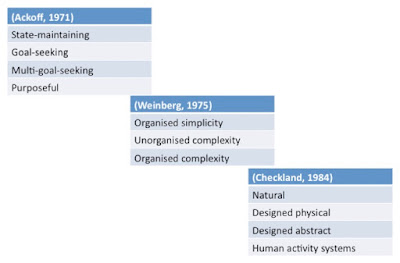
Figure: Classifications of system types.
SYSTEMS THINKING
Systems thinking analysis can be used to illustrate and group the problem domain of trade-offs between the scale of a system and its connectedness as depicted below. We can imagine a problem space for systems thinking to vary along the dimensions of complexity and randomness, or as suggested (Figure below), by connectedness and scale (complexity and complication). I have adapted Weinberg’s terminology in this diagram his original axes were x=complexity, y=randomness however the original intent remains the same; to characterize a conceptual problem space between mechanistic models and statistical models which he termed ‘medium number systems’ or ‘organized complexity.’
Different regions in the problem space are amenable to either: analytical, statistical, or (as Weinberg argues) a systems thinking approach. Recalling the trade-off between scale and connectedness. The first category: organised simplicity, describes relatively well-described simple systems that may be modelled analytically or deterministically as machine-like systems. The second category: unorganised complexity may be modelled statistically and applies in situations with sufficiently large, complex populations when aggregate behaviour begins to approximate stochastic (probabilistic) processes. The third category: organised complexity, describes dynamic structure-determined systems as evidenced by emergent properties and behaviour. These are medium number problems that are…
“too complex for analysis and too organized for statistics. This is the region of systems.” (Weinberg, 1975)
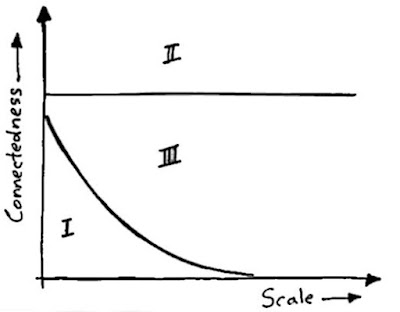
Figure: Types of systems with respect to methods of thinking (adapted from Weinberg, 1975)
Mid-range complex systems are typically the subject matter for management, engineering, sociology, and politics. They deal with problems that are dynamic and interrelated but essentially beyond finite analytical modelling because factors cannot be isolated or parameterised, or the computational load of a detailed model is excessive or based on unrealistic assumptions. Yet these problems are not large enough or randomised such that stochastic or probabilistic methods are useful for predicting or managing outcomes.
MID-RANGE COMPLEX SYSTEMS
So what is a mid-range complex system? Weinberg suggests that it is an open evolving system. The assumption of being bounded and approximately mechanical does not hold. It is a structure-determined system that adapts and evolves over time. A mid-range complex system is coupled with its environment and its boundaries are defined by its interfaces; processes of interaction and transformation with the environment it exists in and which it in part constitutes (Winograd and Flores, 1986).
How do system-like effects arise in the environment for high tech product/services? High-tech products typically invoke new system-like behaviour from users that over time begins to pervade the lives of individuals, families and groups in ways that we cannot predict with certainty.
EXAMPLES: The following examples depict the emergence of system-like interaction and behaviour arise between people and high tech objects (credit: Stefan Klein).
The telephone is not just another way to talk to someone over a wire; the mobile phone is not just a traditional telephone without a wire. The telephone, a spatially fixed communications device, could never attain the pervasive availability and use that the mobile phone has achieved. Mobile telephony has led, in turn, to the discovery of novel forms of coordination, collaboration and surveillance. It has redefined the notion of availability, and dramatically extended the scope of options to get information or call for assistance in everyday situations.
RFID technology was designed for simple product identification, but it can also be used for tracing and tracking things, ranging from the identification of licit products to the surveillance of teenagers. The meaning that is assigned to technologies and their modes of use is highly contingent on the context of use, (groups of) users, their relations, etc.


