Wednesday, 16 October 2024
Product (inc. Service) Design Resources
Wednesday, 18 September 2024
Research Project
GENERAL GUIDELINES
0. Scope
The scope for this year's research project, the Game Design Evaluation, is outlined in the document linked here...https://managingdesignanddevelopment.blogspot.com/2023/09/scope-for-term-paper-2023.html
1. Goal
Study a product (see Scope above) using a small selection of product-design research methods chosen by you (but not surveys or questionnaires). You will apply a small number of empirical research methods to scrutinise an object or system that you have access to can interact with people who use it. Your aim is to better understand the use of the object. A secondary aim is to form an opinion on the efficacy of the chosen methods. You will generate data and findings applicable to the object (and methods).
Tips on how to start this project...
- Phrase your investigation as a question - the "Working Title". Initially, phrase a research question as the title of the paper (you can change it later).
- Identify an exemplary paper that you aspire to emulate or to compare your own paper with.
- Write a statement of intent: This will probably evolve into the 'abstract'. Restate and expand on the research question in the abstract (you can change it later when you have analysed your findings).
- Consider Research Access: Do you have an interest in a particular product, or contacts in a company developing a product? Do you have access to a company that you would like to better understand or experience working on a project that would benefit from being studied like this?
1. Wording of the Title stated as a question?2. Is/are the research target(s) identified?3. Is/are the research target(s) accessible?4. Are research methods stated?5. Are the research methods suited?6. Did you use the template?
2. Deliverables: Term-paper plus video presentation
Term-paper: Paper May Not Exceed Ten Pages Including References.A 1-page Personal Reflection to be written and included as an appendix.Appendices are not included in the page count limit.
You are expected to create your own original narration and/or spoken audio content, similarly you should utilise as much of your own visual/graphical material as possible. You can of course utilise various elements sourced elsewhere (subject to licence) as background or linking pieces, e.g. diagrams, music etc. if needed as content or for artistic balance.Grade deduction if the presentation/video has text-to-speech narration or uses 'canned animation.'While not being graded separately from the term-paper, no presentation video results in losing half the available mark for the research project.
3. General pointer on writing...
The term paper is written in an academic style, presenting your background reading, method, research, analysis, theorising and critiquing aspects, for example of the history, situation, processes etc of a particular sourcing context.You must use the scientific conference template for the Hawaii International Conference on System Sciences (HICSS). Choose between either the LaTeX or Word template - copies of both are available on Google Drive, links below.
- Word template (https://drive.google.com/)
- LaTeX template (https://drive.google.com/)
- Papers should be submitted in Brightspace as a ".pdf" file.
4. Structure of a typical journal style research paper
Title
The title and abstract should both capture the essence of the study.
Abstract
Introduction / Literature (positioning)
Give a brief introduction to the literature and positioning for the study.
Research Design / Methods / Context
Outline your research protocol, approach etc.
Data / Findings
Tell the story, provide the evidence, findings, account or narrative.
Analysis / Discussion
Analysis and discussion allow you to draw out the significance of what you have discovered. This is where you can apply/trial various analytical models or produce your own interpretation of the data, in order to better understand the evidence.
Conclusions
Conclusions summarise the findings concisely, often in a page. This is an overall synthesis distilling your analysis and its relevance to theory and the literature.
Bibliography/References
The bibliography/reference section is crucial to get right as it is the index to prior research and literature that you have referred to previously.
Appendices (if needed)
Use appendices to provide additional detail if necessary. Usually data samples, or intermediate representations, for example a sample of the data analysis process, coding frames, stages in the coding and summary or intermediate categories from data.
5. Grading
Grading will consider the following criteria:- The research project is clearly explained.
- Critical positioning in literature.
- Empirical work, data and evidence presented.
- Overall quality of the document as a finished product.
- Contributions are clear.
A brief explanation of letter grade descriptors is provided below.
A+/A
- The report is suitable for submitting to conference, journal, or executive with little revision.
- There is a compelling logic to the report that reveals clear insight and understanding of the issues.
- Analytical techniques used are appropriate and correctly deployed.
- The analysis is convincing, complete and enables creative insight.
- The report is written in a clear, lucid, thoughtful and integrated manner-with complete grammatical accuracy and appropriate transitions.
- The report is complete and covers all important topics.
- Appropriate significance is attached to the information presented.
- Research gathered is summarised in some way, research and analytical methods described and discussed, evidence linked to argument and conclusions.
- The report may be suitable for submitting to conference, journal, or executive if sections are revised and improved.
- There is a clear logic to the report that reveals insight.
- Analytical techniques used are appropriate and correctly deployed.
- The analysis is convincing, complete and enables clear insight.
- The report is written in a clear, lucid, and thoughtful manner-with a high degree of grammatical accuracy.
- The report is complete and covers all important topics.
- Appropriate significance is attached to the information presented.
- The report may be suitable as a discussion draft for further development or refinement.
- There is a clear logic to the report.
- Analytical techniques are deployed appropriately.
- The analysis is clear and the authors draw clear, but not comprehensive conclusions for their analyses.
- The report is written in a clear, lucid and thoughtful manner, with a good degree of grammatical accuracy.
- The report is substantially complete, but an important aspect of the topic is not addressed.
- The report may have used or presented some information in a way that was inappropriate.
- The report may be suitable as a preliminary draft but needs substantial revision in a number of areas to develop further.
- The basic structure of the report is well organised but may need rebalancing.
- The content of the report may be partial, incomplete or unfinished with important aspects not addressed.
- The report used information that was substantially irrelevant, inappropriate or inappropriately deployed.
- The report’s analysis is incomplete and authors fail to draw relevant conclusions.
- The report may contain many errors in expression, grammar, spelling.
- The report may appear to be preliminary, speculative, and/or substantially incomplete.
- Whatever information provided is used inappropriately.
- The structure of the report may be inappropriate or need substantial reorganisation and/or rebalancing.
- There may be little analysis, evidence may not be founded, the findings may be inconclusive.
- The report appears to frequently use information that is substantially irrelevant, inappropriate or inappropriately deployed.
- The report may be poorly written, organised and presented.
- Frequent errors of grammatical expression.
Monday, 9 September 2024
Scope for the Term Paper
Game Design Evaluation
A design evaluation of an indie boardgame released at Spiel 22, Spiel 23, Spiel 24 e.g. see the Spiel website - SPIEL ESSEN - https://www.spiel-essen.de/en/ Each student to select a recent game published within the last 3 years. No mainstream games or videogames. Cross check the game details on BoardGameGeek BBG https://boardgamegeek.com/.
The term-paper will be a practical project based on your personal-plus-friends evaluation of an indie (independent/small company) board game as the 'whole product'. You will consider overall design, its playability, potential for improvement, its digital aspects or digital potential, and product variants such as expansions, spin-offs etc.
Audience: Create a document that tells a story that people such as the designer, investor and publisher would benefit from learning about what you learnt by using and observing others using the product. It could be a useful input for a journalist to use in preparation for writing a product review. Content and structure may include any/all of the following...
Pitch warm-up
---------
In a sentence “It’s like…”
Single player, multiplayer, puzzle, builder, collaborative, cooperative, competitive, open-world, sandbox etc?
Family/Adult, player age, number of players, time to play. Casual vs campaigning etc.
Background research
----------
Inspiration?
Genre?
Related titles in this genre?
Published influences, related and similar titles (even, if you look for it, references in the game literature!!!!)
Design structural elements
--------
Game design elements? Gamifications?
Outcomes? Win/lose? Display/sharing?
The application of emotion principles?
The application of the uncertainty principles?
Narrative backdrop constructed by the design
Narrative potential constructed by the players
Complexity, scope? Too much, too little?
Developer perspective
------
Paper prototype or mock-ups?
Any playtest feedback?
Comment on ease to ‘onboard’ new players? Simple version, complex version. House rules.
Identified ideal player types, market segment? Appeals to who?
Market perspective
-------
Potential to adapt or expand, levels, extent, add-ons, expansions? Is it a platform.
Market size of equivalent or similar titles?
Route to market? (publisher, self-publish, Kickstarter, Gamefound, crowdfunded)
Packaging/presentation? (box, components, online, platforms) look and feel.
Countries/languages? Cultural fit. Suggest markets.
Product Production: Value, costs, price, effort
--------
Price-point/Pricing? Cost to design/develop?
Cost to service/operate?
IP or licensing questions?
Potential to rebrand or repurpose the ‘engine’ to another genre?
Wednesday, 20 September 2023
Writing a precis
The commentary or précis of a reading/article conveys what you understood, learnt, and how you might use the knowledge. Consider expanding your commentary to include a section for a critical or analytical interpretation, i.e. what is the intention of the authors, who is the audience, how valid are the claims?
- Q: Who are the authors?
- Q: What is your key takeaway from this article?
- Q: Can you highlight one key quote for the audience?
- Q: What do you think is the value or importance of this article?
- Q: So where are we today in terms of this topic?
- Q: another question?
- Sentence 1:Name of author, genre, and title of work, date in parenthesis; a rhetorically accurate verb (such as "claims," "argues," "asserts," "suggests"); and a THAT clause containing the major assertion or thesis statement in the work.
- Sentence 2: An explanation of HOW the author develops and supports the thesis, usually in chronological order.
- Sentence 3: A statement of the author's apparent purpose, followed by an "in order to" phrase.
- Sentence 4: A significant quote from the paper used in a sentence.
Writing tips:
Focus on the article being reviewed, not so much on other readings, books, articles etc.
Please do identify key quotes from the article. These a short statements or at most a sentence or two that distil some essential aspect of the article. A key quote is used: to point to the authors' evidence or claims; to make a justification for your own arguments; to act as a foundation for your own ideas. However, there must be clear delineation between the authors' content and your use of it.
- For quotes: use quotation marks followed by cite.
- For paraphrasing: follow with cite.
- For extracts and transformations like lists and tables: explain source followed by cite.
- When reviewing, do not quote the author's quotes of other authors. Instead, quote an original passage written by the author of the article you are reviewing.
Please use double quotation marks and page number to identify "the quoted text" p. 23. You could apply one of the standard citation methods if you like e.g. Harvard style:
- (Surname et al., Publication Year, p.#)
- (Surname et al., Publication Year, pp.#-range)
Wednesday, 16 November 2022
Exercise: Experiment with a research method
Materials:Copies of the research method protocol template. Use the template to structure your experiment with one or more of the research protocols based on the cards from IDEO.
Choose at least one protocol, but even better if you try more than one, if you have the interest or time available.
Context:
Identify an object or context for field work. Possible examples include:
- Stairs
- Doorways
- Queuing in a café
- Anywhere with a queue
- Parcel drop services
- Anything with a touchscreen
- UCD directional maps online and on-campus
- Dublin Bus website
- ATM machine
- Train/LUAs ticketing
- Supermarket Self-service checkout machines
- Copier machines at the Copi-Print system
- UCard Top-up
- Printer
- Kindle or other E-reader
- Brightspace (from student’s perspective)
- Alarm System
- Airport Self-service Checkin
- Tesco’s Online Shopping website
- UCD Library catalogue
Schedule field study observations over several days.
Instructions:
- Write your name and the research context on the form
- Investigate and propose your own version of the procedure for the research method assigned to you. Base this procedure on readings or your own creative extrapolation of the description on the IDEO methods card.
- Conduct a trial run of the procedure on yourself first, then involve another willing participant, and another...
- Make hand-written notes, photos and recordings for later analysis.
- Keep a record of evidence gathered.
- Make an archive of data/records (paper sketches and notes, digital folder, website).
- Present your findings and analysis at the next class.
Research Protocols
Ideo (2003) IDEO Method Cards: 51 Ways to Inspire Design. William Stout.
LEARN
| Research Method | Description |
|---|---|
| Activity Analysis | A description of project relevant dynamics: actions, interactions, tasks, and objects of achieving goals. |
| Affinity Diagrams | Represent or diagram clustering of design elements with activities, goals, obstacles. Proximity, dependence and relationships |
| Anthropometric Analysis | Human factors or ergonomics to assess project relevant use factors. |
| Character Profiles | Personas. Archetypes of real people with real goals, lifestyle, behaviour, identities. |
| Cognitive Task Analysis | List, summary of all available sensory inputs decision points and actions. |
| Competitive Product Survey | Collect, compare, and conduct evaluations of extant and competitive products. |
| Cross-Cultural Comparisons | Personal accounts of differences in situations, behaviour and artefacts in different national or cultural settings. |
| Error Analysis | Capturing the things that actually go wrong in the project relevant setting. |
| Flow Analysis | The flow of information in existing and/or new system. |
| Historical Analysis | Identify trends and cycles of product use, customer behaviour, market, and practice. Relate to timeless goals |
| Long-Range Forecasts | Narratives of future scenarios complete with social and technological trends to predict behaviours. |
| Secondary Research | Summary analysis of existing sources and 3rd party data on project relevant areas. |
LOOK
| Research Method | Description |
|---|---|
| A Day in the Life | Catalogue a person’s whole day without necessarily focusing on project relevant aspects. |
| Behavioural Archaeology | Look at use, wear, the detailed arrangement or organisation of use objects in their use setting. |
| Behavioural Mapping | Map position, movement, and use of space over time. |
| Fly on the Wall | Observe in context without interfering. |
| Guided Tours | Ask the user to guide you through project relevant spaces and activities. |
| Personal Inventory | Ask the user to reflect on and describe the things they view as important or significant |
| Rapid Ethnography | Participate and experience it first-hand with the user for as long as possible. |
| Shadowing | Tag-along with people through the day. |
| Social Network Mapping | Notice the relationships between people, groups. Look for identity, profession, culture, and connections. |
| Still Photo Survey | Build up a visual record of key use and interaction moments over time. |
| Time-Lapse Video | A way of summarising activity over time, use of time, space, and location. |
ASK
| Research Method | Description |
|---|---|
| Camera Journal | A written and visual diary of project relevant circumstances and activities. |
| Card Sort | Organise cards spatially in ways that make sense. To expose mental models of device or system. |
| Cognitive Maps | Create a map of an existing or virtual space. The pathways they know and navigate, mental models. |
| Collage | Self created collage of arranged images. Used to help verbalise complex or unvocalised themes. |
| Conceptual Landscape | Sketch and juxtapose social and behavioural constructs from participants. People’s mental model. |
| Cultural Probes | A visual journal for participants to build up themselves. A self generated reflection. Gathered and compared across many participants. |
| Draw the Experience | Ask participants to visualise and draw the experience in their own way, with their own associations, order, relationships, theories. |
| Extreme User Interviews | Evaluate (ask) users at extreme ends of market (early adopters, power users, beginners) to highlight their issues. |
| Five Whys? | Ask “why?” in response to five consecutive answers. Expose/uncover deeper attitudes perceptions. |
| Foreign Correspondents | Elicit inputs from others (snowball sample) to build up varied cultural and environmental contexts. |
| Narration | Users perform tasks and achieve goals while describing aloud. Talk aloud protocol. Stream of consciousness. |
| Surveys & Questionnaires | Targeted questions to assess design, usage, interaction characterises and perceptions of users. |
| Unfocus Group | Gather a range of tools or materials and get diverse user group to create things relevant to the design or project. |
| Word-Concept Association | Users associate words with design. Cluster user perceptions to evaluate design features & concepts. Value and priority. |
TRY
| Research Method | Description |
|---|---|
| Behaviour Sampling | Snapshot people’s activities at different times. How do pervasive products intrude in your lives? |
| Be Your Customer | What is it like to purchase your product? Actual experience of searching, buying, consuming, disposing. |
| Bodystorming | Act out scenarios with many people, using space, place, sequence, queues, etc. Test performance in context. |
| Empathy Tools | Experience the range of users capability for involvement under real conditions. |
| Experience Prototype | Mock up a rough but workable prototype to simulate the experience of using the new product. |
| Informance | Act out scenarios observed in the field to interpret and analyse in the lab. Builds shared understanding and good for solution formation. |
| Paper Prototyping | Rapid paper based mock-ups that are manipulated to demonstrate functionality. To articulate design concepts with users. |
| Predict Next Year’s Headlines | Involve users in future design possibilities. Futuristic, wishing, unmet needs. Help separate what is needed now from what can wait. |
| Quick-and-Dirty Prototyping | Assemble a very rough mock-up of a new feature or product to help start and refine a design. |
| Role-Playing | Identify actors/stakeholders involved in design use, enact real activities in real or imagined context. |
| Scale Modelling | Simulation technique to test arrangements of space, place, context. |
| Scenarios | A character-rich story, to communicate (simulate) and test a plausible story in probable context. |
| Scenario Testing | Show depictions of possible future scenarios. Share reactions, refine concepts. |
| Try it Yourself | Like Microsoft’s famous ‘eating our own dog food’ being the first user. |
General comments on doing field research
On learning about methods
Some comments by way of general orientation to a research exercise:
- Be curious and open to discovery
- Goal oriented analysis often yields interesting findings.
- Be open to identifying insights, deep insights, particularly "what I learnt".
- Look out for the unexpected, things that are puzzling, aberrations.
- Self-reporting can be hugely insightful, this can be researcher self-reporting or respondent/subject self-reporting.
- Don't get side-tracked by 'annoyances' when there is an elephant in the room.
- When making recommendations or advising on solutions
- Contrast with comparable experiences, goals, solutions from other industries.
- Contrast with completely incomparable solutions from completely different settings.
- Avoid 'selling' a new tech system as if it is a holy grail or nirvana solution. All tech systems have their failings, you may simply be changing the source of your pain, not taking it away.
- There is huge value in a quick-dirty prototype.
- Use paper sketches, paper prototypes, mock-ups, from low to medium to high fidelity.
- Design ideas (sketches, mock-ups, prototypes) are used for feedback, for learning.
- If a design proposal is quite narrow, if so then it must be very focused, well argued, and insightful.
- NO DANCING BEARS! For an explanation see Alan Cooper's book "The Inmates are Running the Asylum" (search link)
- Respect your research subjects' privacy-identity
- It's generally seen as good practice to anonymise your interviewees if putting information in the public domain unless it is absolutely necessary for some reason.
- I recommend redacting personal identities from reports and papers.
- Be aware of copyright and attribution
- You cannot post other people's copyright material online.
- If you 'copy-paste' content from someone else make sure you surround it with quotation marks and include a citation or attribution.
- Do please make posts on your websites that are your own writing.
- Be aware of and comply with copyright law and conventions for fair use, attribution etc.
On Surveys and Questionnaires
I am not particularly interested in student projects that use surveys or questionnaires as the main or even as supporting research methods.It is also rare that we see well justified and well designed questionnaires or surveys. In fact these methods require that that the researcher has already studied (through literature review) or actually conducted extensive primary empirical research and/or carried out medium scale studies before resorting to survey/questionnaire. The findings of prior studies provide the justifications for determining what, why and who to ask. There will be clear connections between foundational research findings and the very design of a survey/questionnaire instrument. The content and sequence of each question is there for a valid research reason. The method is an inherently closed style of questioning and is therefore a kind of 'forcing function'. It produces limited responses responses to focused questions and therefore carries the risk that you will only detect what you expect to find, the method is quite literally self-determining and often results in poor science.
The design of surveys and questionnaires must needs be subjected to scrutiny, refinement and quality checking in order to avoid problems ranging from avoiding leading questions through to establishing construct validity. For example, is it essential for the research that you capture the respondents gender? Why? Is this justified? If so how many categories are you providing? Male/Female? Does the respondent have to answer or can they opt out? If so how does this affect the data and your analysis of it?
Surveys and questionnaires have their uses, for example where the concepts are well defined, not subject to misunderstanding (ref. construct validity), and the questions being addressed can usefully be asked of a large sample population. Therein lies my last bugbear with survey/questionnaire, sample size. A survey with 8 respondents is technically useless unless the whole population is 8. Statements based on small sample sizes are likewise in general useless unless you are sampling small absolute populations. Plus, survey responses are often presented in ways that mislead us as to their significance, for example, "100% of survey respondents answered yes" creates a different impression from "8 survey respondents answered yes".
So when does a survey sample size reach statistical relevance? The answer to this question depends on the margin of error threshold you seek to pass. Notice when talking about populations we generally refer to the sample size, a subset of the population. The implication being that we don't expect to be able to contact every single member of a target population, merely a subset. So what sample size do we need to reach to make reasonable inferences about the entire population? The margin of error or confidence level desired are in fact functions of population size; see "survey population/sample size calculator" for further information.
![]() |
| Survey population-sample size calculators |
The Difference between Citing References and Field Data
References and citations should relate to the subject matter being written about. Field data and interviews etc. gathered from a field study site does not constitute reference material in the same way; in this case a quote from the data is simply data not a citation. Similarly survey results are only included where relevant to the arguments or analyses being made, the entire survey with responses should not be appended to the paper. Research instruments and the gathered results may, if desired, be included in an appendix at the end of the document.Wednesday, 19 October 2022
Exercise: Writing an Academic Article
This exercise introduces MS Word style sheets and References...
The following illustrative exercise uses the ECIS template on Google Drive (link).
2. Rename your file using the following pattern "Surname_MyResearchProject_YYYY.doc".
For example my own paper is going to be "HigginsEtAl_WorkingInVirtualLight_YYYY.doc". I have used the author convention "SurnameEtAl" as there are three or more authors.
3. From the MS Ribbon "Home" open the Styles Panel. The "Current style" field show the current text style wherever the cursor is in your Word file. Alternately navigate to top menu "Format>Style" for similar.
![]() |
| The current style at cursor location |
4. Select section 1 "First level heading" and rename it "Introduction"
5. Paste and match formatting using following unformatted text as new paragraphs for section 1
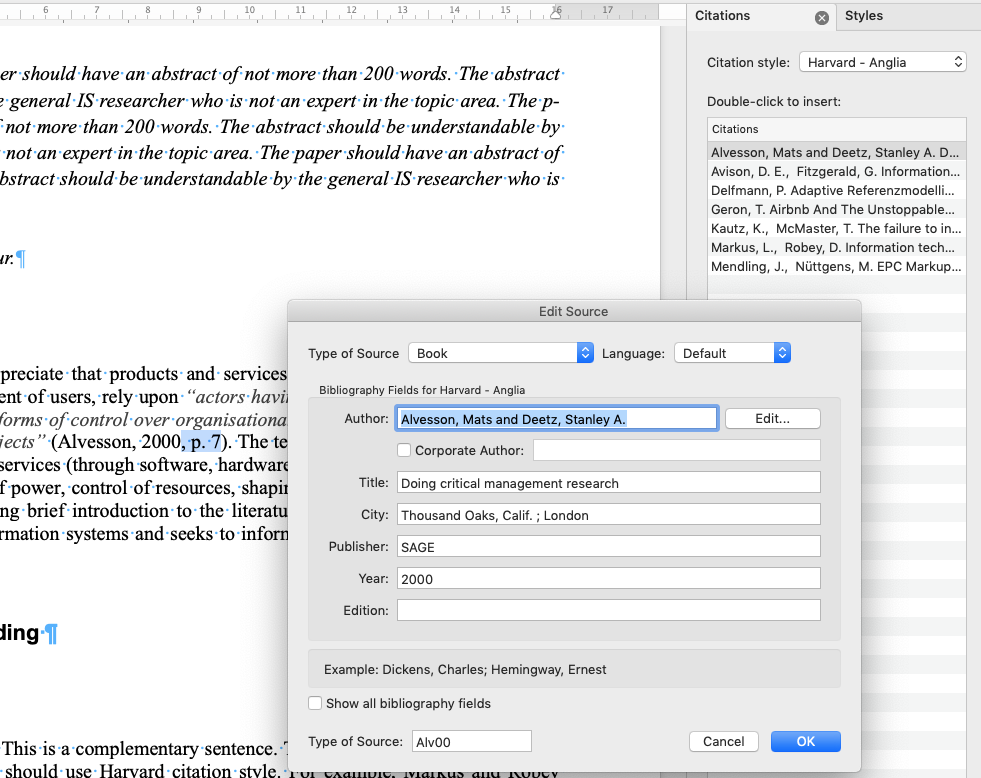
Critical management studies appreciate that products and services, produced with technologies, by organisations, and the involvement of users, rely upon "actors having formal and symbolic resources for the exercise of... systematic forms of control over organisational participants, and indirectly over other groups and non-human objects"\citep{AlvDee2000aa}. The techniques and skill of management for producing digital goods and services (through software, hardware and systems) at its best aims to resolve this through the delicate, democratic balancing of power, control of resources, shaping of work culture, and leadership \citep{Kid1981aa}. The following brief introduction to the literature positions this study within the broad field of management information systems and seeks to inform further creative, design, and development initiatives.This study looks at...
6. Confirm that the paragraph current style is "Basic text"
7. Select the following text and change its style to "Subtle Emphasis". You many need to filter the style list selection at the bottom of the styles window.
“actors having formal and symbolic resources for the exercise of... systematic forms of control over organisational participants, and indirectly over other groups and non-human objects”8. With the MS Ribbon "References" active...
![]() |
| Create a new citation source record |
![]() |
| MS Word's new citation source editor |
![]() |
| Adding Tracy Kidder's Soul of a New Machine to the citation list in your MS Word document |
![]() |
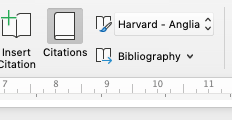
| n.b. the bibliography style-type (Harvard - Anglia) and the insert "Bibliography" command |
For further background refer to the notes on the term paper at:
https://managingdesignanddevelopment.blogspot.com/2015/04/term-paper-and-presentation-guidelines.html
Writing styles: The term paper is written in an academic style, presenting your background reading, method, research, analysis, theorising and critiquing aspects, for example of the history, situation, processes etc of a particular sourcing context. Consider identifying an exemplary paper that you aspire to emulate or to compare your own paper with.
You must use the specified scientific conference template for the term-paper. Choose between either the LaTeX or Word template from the ECIS 2015 conference. Copies are available on (Google Drive link). By using and sticking with the ECIS template your paper will automatically conform with the scientific format guidelines for that conference.
Self-assessment for this exercise:
- Did you upload the file (e.g. word file)?
- Did you use the correct template?
- Did you add a new source record into the document?
- Did you insert a citation into the text of the document?
- Did you regenerate the bibliography/references at the end of the document?
Sunday, 18 October 2020
Previous research topic-titles
- Mobile banking: the study of AIB mobile bank application.
- Brain-computer interface for medical: evaluating the usability of brain chip for disabled person.
- Gillette's marketing campaign: a sentiment analysis on Twitter.
- Assessing the usability of taxi application Free Now.
- How does ClubMed resorts design daily events.
- A study into the growing influence of the internet of things in the modern household.
- Assessing the usability of 12306 ticket purchase system.
- Google Lens: evaluating the usability of AI & AR powered mobile application in today's world.
- Digital-only banking: evaluation of Alat Nigeria's first fully digital bank.
- Digital learning/e-learning: evaluating the usability of an e-learning model (Byju's)
- Google Fit: encouraging you to exercise more.
- Replacing B2B sales contacts with a website: an exploration of human-centered design methods for a loyalty solutions startup in HORECA industry.
- Social Listening for Innocent Ireland.
- A Study and Initial Report on a Requirements Elicitation Process for an Encrypted National Telehealth Conferencing Platform
- Ripple for cross-border payments: evaluating Ripplenet as a payment solution for banks and financial institutions.
- Too good to go - a technology-based approach to food waste management.
- Research on the usability of mobile short video TikTock.
- Utility of interviews, surveys and prototyping within the context of improving user experience of smart travel card mobile applications.
- HDFC EVA: can a chatbot replace customer service agents?
- Gamification of eco-apps: assessing the implementation of gamified elements to improve user engagement of the application Litterati.
- Evaluation of Historical Analysis in context of Atlassian’s product strategy and Survey to analyse users’ attitude on Jira.
- Paytm an e-wallet: assessing the usability of mobile based e-wallet application.
- Usability in context: a case for the Joulebug app in motivating local environmental stewardship
- Usability analysis: Paytm digital wallet - one step closer to a cashless economy.
- Adaptability of Google Pay in India and Ireland.
- Innocent Smoothies Ireland case study: Twitter campaign impact * strategies comparison
- Revolut for banking: assessing the usability of the app as a new electronic money institution.
- Brightspace: an investigation into improving participation and engagement with the learning management system discussion board.
- Analysis of Uber's disruption to the traditional taxi-service industry
- Evaluation of Textual and Sentimental analysis methods in the context of social medial campaign Gillette 2019 ‘Men Can Be Better’ on YouTube.
- Re-designing a more social spotify UX in mobile.
- Usability Assessment of Oneview Patient Engagement Application Based on Empirical Evidences
- Growth of the online food industry: comparative analysis of the two online food industries Swiggy and Zomata in India.
- How do Results of Unmoderated and Moderated Think-Aloud Protocols Differ in Usability Evaluations?
- Swipe Left on Ghosting: A Usability Analysis of Tinder’s Chat Function
- Conversational AI and Smart Speakers: Usability & Requirements Study
- A Diary Study in the Context of Smart Furniture for Remote Workers
- Innovation Reading in the Digital Age: Usability, Requirement Analysis, and Feasibility Study of Blinkist
- Redesigning Notification Badges on iOS 12 and its impact on user’s task engagement
- Evaluating the Usability of the Collaborative features on LMS Blackboard Learn
- Improving User Experience of IRCTC Rail Connect App by Incorporating Human Computer Interaction Guidelines
- Contactless Payment in Germany
- User Privacy on Apple iCloud Photo Library
- Usability Analysis of the GoCar iOS Application
- Empathy Tools Critique
- Empirical Study on the Build-In Anti-Theft Measures of High-end Android Smartphones
- What are Technological Tools That Facilitate Mentorship and Employment of Persons with Disabilities? A Case Study on Nextbillion
- Understanding, applying and evaluating the use of eye gaze tracking software: lessons learned evaluating company career websites
- Improving Ctrip Mobile App as a user-friendly one-stop-shop
- The Prevention of Falsified Medicines in Ireland – An Analysis of The Irish Medicine Verification System (IMVS)
- VR for Learning: Assessing the Usability of Mobile Based VR Headsets in Classrooms
- An Enquiry Into Motortrans.ie
- How effective are the gamification features in the Apple Watch in promoting physical exercise? A diary study.
- What Type of Data is more Suitable for Assessing and Improving the Usability of a Chat-Bot?
- SDL Trados and OmegaT – A Comparative Analysis of Usability of the Main Features
- Comparing the Technology Behind Nest Learning Thermostat to That of a Conventional Thermostat Along With Their Energy and Cost Efficiency
- How Can Netflix’s Search Feature be Improved for Users?
- Managing Organizational and Process Innovation – Lessons Learned From a German Non-tech SME
- Usability Analysis of Flightradar24 Mobile Flight Tracking App
- Shop Code: Usability Testing and Redesign Proposal
- How Drones Can Leave The Hazardous Zone
- Usability Study and Redesign Proposal for the Google Play Store app
- Using the Trinity ID as a starting point, how can iDly update that system in order to enhance the features of their digital ID cards?
- How to improve the Dash students’ experience?
- Housemydog.com: how to enhance the design and development features of a dog minding platform through a usability and feasibility study
- BRS Golf Booking System
- Plynk - the money messenger
- Can sleep apps improve your sleep troubles?
- Improving Hailo
- Aer Lingus iOS app usability study
- Usability analysis on IPF app for Patient M Power
- How can the “dublinbikes” mobile application better reflect and channel the innovative nature of bike sharing
- The Dublin Bus Mobile Application: usability analysis
- GiapSchool usability study and improvement
- UCD Mobile: Usability & Requirements Study and Development proposal
- Roomys Evaluation and Improvement Project
- Effy solutions usability study and design proposal
- Metrifit usability, requirements analysis and feasibility study to update extant system.
- External Brain: Experiencing Evernote
- Design and development proposal for ChildDiary v2.0
- Buymie v1.2.0 – Usability Study
- “Pay and Display” Is displaying necessary?
- Cocoon: Lessons Learned From Evaluating a Software Startup.
- A proposal for an Enterprise Resource Planning (ERP) system upgrade
- (Kammavari Sangha Institute of Technology) KSIT website debunked
- Redesign and Recreate a System for an Agency of Home Appliances Maintenance and Repair Services
- Improving Trancehub
- Selling, Point of Sale and Shop Systems for JD Sports
- Smart Baggage Claim for RFID Enabled Airports
- Coapp - collaboration tool for web designers
- A Website Redesign of Ard Scoil Ris
- Upgrading of Irish Light Rail ‘Luas Tram’ Ticketing and Fare Collection Machine
- ‘Echo - The Premier Communication Application’
- In-Car Voice Interaction System Redesign Proposal
- Product for Bass Guitar to Midi Converter
- Website Redesign Proposal for U.C.D Applied Language Centre
- Redesigning Dublin’s Traffic Control System
- Redesign of an Existing System Cineworld Ticket ATMs
- Daft.ie Using Technology to Restructure Services
- Tesco Mobile App: Connecting Recipes and Shopping function
- UX/ID for Irish Multiplex Cinemas
- To Improve the User Interface of the Blackboard Learn System
- A Redesign Proposal for the Coillteoutdoors.ie Website
- UPC Horizon UX Issues
- CRM for an Online Insurance Broker - A Case Study
- Stamp App - The Future of Postage Stamps
- Redesign Proposal of PAYE Anytime
- Android application for shopping and payment purposes with the use of NFC technology
- HR System Functionality and Leave Management
- Online Banking: A study of two Irish Bank’s and Possible Improvements
- Leap Card New payment system proposal
- Improving RTE Player
- An Analysis and re-design of the current E-xamit website
- Tool Repair System
- UCARD System Development
- Self-Service Library Machine: 3M ‘R-Series Model ‘8600’
- Improving Tesco Self-Service Checkout
- Bank of Beijing Personal Internet Banking System
- SiSWeb – Redesign Proposal
- Enhancing the Reporting Capabilities of a Banking Organisation
- I-Concentrate - Control access to Apps, Networks, and Websites
- A Redesign of the Current ATM System in Ireland
- Improving user Experience on CopiPrint Machines
- Introducing Mobile Payment to Irish Transportation
- Bus Éireann Website and Tech Services
- An Analysis and Redesign of Ticketmaster Event Ticketing Service Provider
- Proposed Redesign of the Mantis Issue Tracking System
- A Redesign of the Twitter Newsfeed
- Analysis of current Intranet Facilities and Proposed Redesign
- Re-design of the Ulysses self-service Help Desk module used by St. John of God Hospitaller Ministries
- Redesign of Ryanair Website
- Ad Server
- LEAP Integrated Ticketing System
- Ryanair.com- How can we do better?
- Report on Sony Entertainment Network’s Online Store And Proposed Recommendations
- Application Virtualization: An Aid for OS Migration (Windows)
- Gamification of McDonalds App
- Dublin.ie Redesign Proposal
- Trolly Folly: An Analysis of the Ryanair Online Shopping Experience
- The Introduction of a paid car parking solution to the UCD Campus locations of Belfield and Blackrock
- Improving the M50 Eflow toll system
- Payzone Parking Tag
- Protecting ATM Users from Fraud
Monday, 20 January 2020
(51) IDEO Method Cards
The idea underlying `Learn' is that hard data, measurements, statements of the facts as they may be known. Observations and data gathered from empirical settings, treating the world as a kind of living lab. This sort of data tends to be treated as more objective, scientific, and provides the material for more statistical and quantitative analyses. It offers the potential for revealing unexpected patterns and insights that demand the use of other methods to understand further. `Learn' methods help us build the data and evidence addressing focused research questions, to follow up hunches and ideas that may be tested or evidenced by measurement data (rather than data mining as such).
The `Look' category implies that people going about their lives and happenings in the world are our best teachers. These are methods for gathering insights from interpretive observations, shadowing and participating in `the wild' [Buxton, 2007]. These methods emphasise the value of the empirical world in the language and terms of its use by its participants. The data gathered depict social realities, actual happenings and incidents; evidence of real people with biographies coping in actual settings, surrounded and constituted in the (seemingly) ephemeral and trivial real-world of people. `Look methods' enable generalised undirected problem identification, the broad assessment of an area before narrowing down on a specific concern.
`Ask' methods seek people's direct participation in constructing research data. People aren't `social dopes', they understand their own conditions. People have points of view and knowledge that they will readily share if you enable them. While this kind of knowledge may be idiosyncratic and bounded the more of it you can gather the more universal may be our understanding overall. `Ask' methods are useful when you have identified a research goal, an application, and a context. They are ways of revealing insider knowledge and practical contingencies that your project will encounter and leverage.
`Try' methods are all kinds of action research, some in-vitro (experimental setting) and some in-vivo (in the wild). These are methods that test how your project may work, how it may change behaviour and understanding, how useful and applicable it is. `Try' methods are active designed interventions and thus quite experimental in character. They encompass controlled simulations, experimental scenarios, to living labs in `the wild'. The focus of these methods is testing. They test feasibility, practicality, understandability. They seek people's active involvement and feedback on the design and application of the project.
- Learn: Analyze the information you've collected to identify patterns and insights.
- Activity Analysis
- Affinity Diagrams
- Anthropometric Analysis
- Character Profiles
- Cognitive Task Analysis
- Competitive Product Survey
- Cross-Cultural Comparisons
- Error Analysis
- Flow Analysis
- Historical Analysis
- Long-Range Forecasts
- Secondary Research
- Look: Observe people to discover what they do rather than what they say they do.
- A Day in the Life
- Behavioral Archaeology
- Behavioral Mapping
- Fly on the Wall
- Guided Tours
- Personal Inventory
- Rapid Ethnography
- Shadowing
- Social Network Mapping
- Still-Photo Survey
- Time-Lapse Video
- Ask: Enlist people's participation to elicit information relevant to your project.
- Camera Journal
- Card Sort
- Cognitive Maps
- Collage
- Conceptual Landscape
- Cultural Probes
- Draw the Experience
- Extreme User Interviews
- Five Whys?
- Foreign Correspondents
- Narration
- Surveys & Questionnaires
- Unfocus Group
- Word-Concept Association
- Try: Create simulations to help empathize with people and to evaluate proposed designs.
(source: the IDEO Method Cards booklet [IDEO, pp. 2-3, 2003])
References
Buxton, B. (2007). Sketching User Experiences: Getting the Design Right and the Right Design. Morgan Kaufmann, San Francisco.IDEO (2003). IDEO Method Cards: 51 Ways to Inspire Design. William Stout, Palo Alto, CA.
Monday, 14 October 2019
Writing - Reading Group
- Reading out one’s work to others
- Author then quietly listens to others' discussion noting agreement/disagreement, comprehension etc.
- Each reader makes one (1) suggestion of how a might point may be made more clearly or forcefully.
Friday, 13 April 2018
The Human Centred Design Kit
IDEO have put together a little book on design research ethics - do no harm right! (link)
"Respect your participants!
Some methods depend upon other people, often strangers, sharing generously their time, thoughts, and feelings. Have consideration for their health, safety, privacy, and dignity at all times.
Her are some principles that guide IDEO's interactions with participants:
- approach people with courtesy
- identify yourself, your intent, and what you are looking for
- offer to compensate participants
- describe how you will use this information and why it's valuable
- get permission to use the information and any photos or video you take
- keep all the information you gather confidential
- let people know they can decline to answer questions or stop participating at any time
- maintain a nonjudgmental, relaxed, and enjoyable atmosphere" (IDEO, 2003)
IDEO.org has also created a set of resources for human-centred design for impact in challenging environments. The Field Guide is a new take on the IDEO design cards which I have used for teaching for a number of years. The examples/cases in the book provide nice illustrations for my students. Go to designkit.org for Design Kit: The Human-Centered Design Toolkit from IDEO for a range of resources and courses - many free.
![]() |
| Books, guides, and free downloads from designkit.org |