Design, Develop, Create

Showing posts with label Readings. Show all posts

Wednesday, 19 October 2022

Exercise: Writing an Academic Article

Use technology to manage a bibliography, referencing and in-text citations.
This exercise introduces MS Word style sheets and References...

The following illustrative exercise uses the ECIS template on Google Drive (link).

1. Copy the template from the shared folder to your own computer.
2. Rename your file using the following pattern "Surname_MyResearchProject_YYYY.doc".
For example my own paper is going to be "HigginsEtAl_WorkingInVirtualLight_YYYY.doc". I have used the author convention "SurnameEtAl" as there are three or more authors.
3. From the MS Ribbon "Home" open the Styles Panel. The "Current style" field show the current text style wherever the cursor is in your Word file. Alternately navigate to top menu "Format>Style" for similar.
The current style at cursor location

4. Select section 1 "First level heading" and rename it "Introduction"

5. Paste and match formatting using following unformatted text as new paragraphs for section 1
Critical management studies appreciate that products and services, produced with technologies, by organisations, and the involvement of users, rely upon "actors having formal and symbolic resources for the exercise of... systematic forms of control over organisational participants, and indirectly over other groups and non-human objects"\citep{AlvDee2000aa}. The techniques and skill of management for producing digital goods and services (through software, hardware and systems) at its best aims to resolve this through the delicate, democratic balancing of power, control of resources, shaping of work culture, and leadership \citep{Kid1981aa}. The following brief introduction to the literature positions this study within the broad field of management information systems and seeks to inform further creative, design, and development initiatives.This study looks at...


6. Confirm that the paragraph current style is "Basic text"

7. Select the following text and change its style to "Subtle Emphasis". You many need to filter the style list selection at the bottom of the styles window.
“actors having formal and symbolic resources for the exercise of... systematic forms of control over organisational participants, and indirectly over other groups and non-human objects”
8. With the MS Ribbon "References" active...
Select the LaTeX citation command \citep{AlvDee2000aa} and replace it with the MS Word equivalent citation, i.e. from the References Ribbon select "Insert Citation". You may need to create a new entry in the Word file's Citations collection
Create a new citation source record

Enter a new source record as follows (n.b. add ", p. 7" to be thorough)
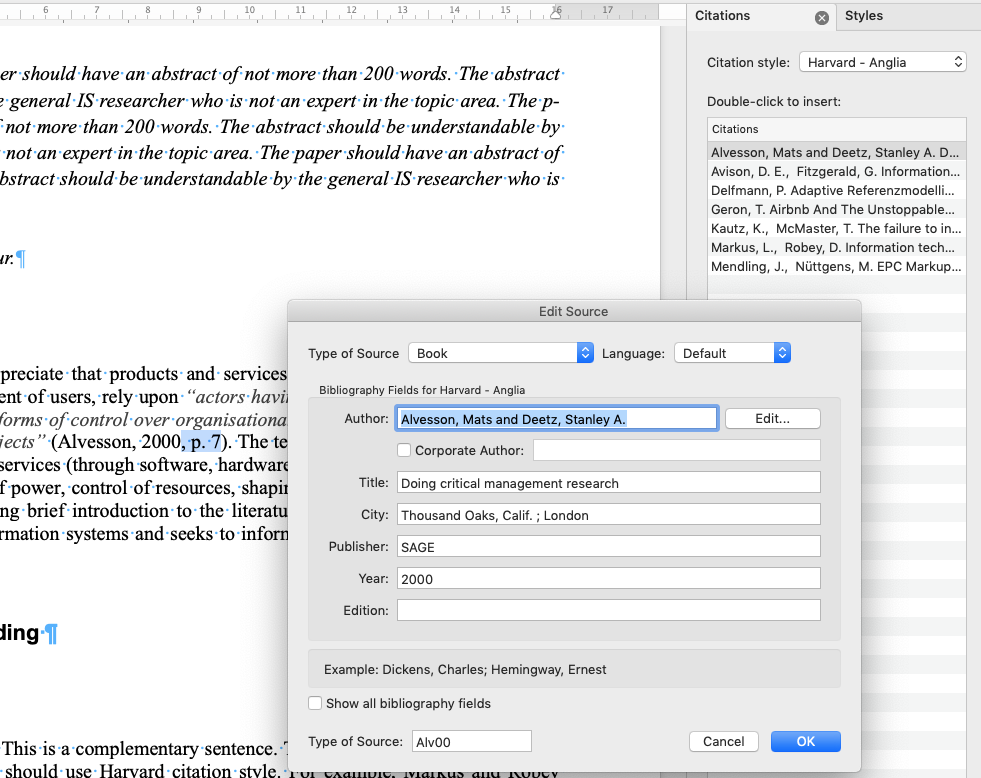
MS Word's new citation source editor

9. Similarly replace the LaTex/Bibtex command for Kidder "\citep{Kid1981aa}" with
Adding Tracy Kidder's Soul of a New Machine to the citation list in your MS Word document
10. Now regenerate the bibliography at the end of the draft paper by navigating to the "References" section, and selecting "Bibliography" to insert a new bibliography. You'll end up deleting the previous copy. You'll also need to reapply the style "Reference" to this text
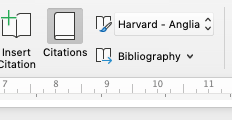
n.b. the bibliography style-type (Harvard - Anglia) and the insert "Bibliography" command


For further background refer to the notes on the term paper at:
https://managingdesignanddevelopment.blogspot.com/2015/04/term-paper-and-presentation-guidelines.html

Writing styles: The term paper is written in an academic style, presenting your background reading, method, research, analysis, theorising and critiquing aspects, for example of the history, situation, processes etc of a particular sourcing context. Consider identifying an exemplary paper that you aspire to emulate or to compare your own paper with.
You must use the specified scientific conference template for the term-paper. Choose between either the LaTeX or Word template from the ECIS 2015 conference. Copies are available on (Google Drive link). By using and sticking with the ECIS template your paper will automatically conform with the scientific format guidelines for that conference.


Self-assessment for this exercise:

  1. Did you upload the file (e.g. word file)?
  2. Did you use the correct template?
  3. Did you add a new source record into the document?
  4. Did you insert a citation into the text of the document?
  5. Did you regenerate the bibliography/references at the end of the document? 

Monday, 14 October 2019

Writing - Reading Group

(a modified `writing - reading tutorial' protocol based on a description by Alexa Zellentin, of her experience running Oxford tutorials)

We read and discuss in turn a draft paper from each of a group of no more than three students.
  1. Reading out one’s work to others
  2. Author then quietly listens to others' discussion noting agreement/disagreement, comprehension etc.
  3. Each reader makes one (1) suggestion of how a might point may be made more clearly or forcefully.
Revision for next week to demonstrate visible progress in the development of the paper - with personal benefits for how interpret feedback; for how to make more nuanced and clearly expressed arguments.

Monday, 12 September 2016

Reading: The Activity Checklist


Kaptelinin, V., Nardi, B. A. & Macaulay, C. (1999) The activity checklist: a tool for representing the “space” of context. interactions, 6, 27-39. (search link)


Read the assigned sections and provide a summary in this live document (and your own website!).

Monday, 25 May 2015

Readings: The ISO and SDLC in the workplace


Fishman, C. (1996) They Write the Right Stuff. Fast Company.

Wareham, E. M. (1994) ISO 9000 and the very small firm. IEE Review, 40, 207-09.


Read the articles and provide a thoughtful observation or question (post to your blog).

Tuesday, 9 October 2012

Readings: Architecture and Agility


Foote, B. & Yoder, J. (2000) Big Ball of Mud. IN HARRISON, N., FOOTE, B. & ROHNERT, H. (Eds.) Pattern languages of program design 4. Addison Wesley.

Beck, K. (1999) Embracing Change with Extreme Programming. Computer, 8.


Read the articles and post a thoughtful observation or question on your own blog!

Monday, 1 October 2012

Readings: Social Research and Coding Techniques

Read chapters 8, 9 & 10 of Strauss, A. & Corbin, J. (1998) Basics of qualitative research: techniques and procedures for developing grounded theory, Thousand Oaks, California, USA, Sage Publications, Inc.

Read chapter 1 of Ragin, C. C. (1994) Constructing Social Research: The Unity and Diversity of Method, Pine Forge Press.


In the same way that the constructs of the social sciences are constructs of the second degree, that is "constructs of the constructs made by the actors on the social scene, whose behavior the social scientist has to observe and to explain in accordance with the procedural rules of his science" (Schutz, 1954) so too the constructs of systems development are constructs of the social actors involved in development, either directly or indirectly (e.g. developers, management, customers, critiques).

Both the research methods for gathering field data, data on customers or users, and the methods or interpreting data, that is data analysis and theory induction, are crucial tools for the business analyst, for the developing requirements, for understanding and interpreting how systems are used and how they can be further developed.

Qualitative research methods are therefore crucial tools for gathering requirements, for trying out designs and their implications 'in use', to reveal unintended uses or consequences arising from new systems (like the Cobra effect), or to suggest gaps that might be addressed.

Reference:
Schutz, A. (1954) Concept and Theory Formation in the Social Sciences. The Journal of Philosopjhy, LI, 257-67.

Read the chapters and provide a thoughtful observation or question (post to the comments section below).

Tuesday, 25 September 2012

Readings: Agile critique and comparison

Cusumano, M. A. (2007) Extreme Programming Compared with Microsoft-Style Iterative Development. Communications of the ACM, 50, 15-18.

Williams, L., Brown, G., Meltzer, A. Nagappan, N., (2010) Scrum + Engineering Practices: Experiences of Three Microsoft Teams. International Symposium on Empirical Software Engineering and Measurement. (link)

Kruchten, P. (2007) Voyage in the Agile Memeplex. ACM Queue, 5, 38-44.


In 1999 the world of software engineering was disrupted by the emergence of agile methods, first Extreme Programming, then the Agile Manifesto followed by Kanban, SCRUM and others. All created as reactions to the then prevailing consensus if not hegemony of stage-wise (aka Waterfall), intending to upend the management heavy methods then prevailing in industry. Today, the worm has turned. The current dominance of "Agile" (with a capital A) creates the impression of a new hegemony; that we should all be Agile, the managers are SCRUM masters, programmers turn backlogs into features, that everything is done in iterations, releasing continuously, designing rapidly, working in Sprints, etc etc. (Higgins,)


Readings: Creativity & Teams


Curtis, B., Krasner, H. & Iscoe, N. (1988) A Field Study of the Software Design Process for Large Systems. Communications of the ACM, 31, 1268-87.

Hargadon, A. B. & Bechky, B. A. (2006) When Collections of Creatives Become Creative Collectives: A field study of problem solving at work. Organization Science, 17, 484-500.

Sawyer, S. (2004) Software development teams. Communications of the ACM, 47, 95 - 99.


Read the articles and post a thoughtful observation or question on your own blog!


Monday, 7 November 2011

Three software development team archetypes

While it is obvious to say that social engagement is an underlying dynamic in teams, the `obvious' is often ignored or even thought of in terms of a problem that must be overcome. Consider instead if we start from the assumption that team structure arises as a consequence of social relations rather than the other way around. Under these assumptions then, the activity of management (not necessarily the job title) can be seen as the act of fostering the social relations of a team rather than manipulating them.

Sawyer's analysis offers some paradigmatic filters to view and manage systems development, as a diagnostic lens and a tool to intervene.
"The sequential team archetype of software development team social structure draws on the work design tradition in industrial engineering. Work is seen as a set of discrete tasks that can be measured." 
"The group archetype draws its intellectual roots from theories of social psychology, such as 'work redesign'. Work redesign arose in response to such issues as personnel motivation, retention, and productivity that typically occur in a work design approach." 
"The network group archetype draws on concepts of social network theory. In this archetype a group of people is linked by the relative 'strength' of the social ties among them. Work is seen as the use of these links to deliver and receive information; these uses both span and define tasks."
Certainly Sawyer's archetypes are just that, archetypes or caricatures. All teams are hybrids but we easily recognise elements of the archetypes at different times and in our own behaviour. Perhaps a key insight is that our individual personalities and temperaments incline us towards one mode or another, perhaps at different times and regardless of the organisational structures in place. And each archetype invokes a specific remedy (communication can overcome the limitations of silos, groups often need direction and control, networks need opportunities to interact and bottle-necks can be a problem).


Reference
Sawyer, S. (2004) Software development teams. Communications of the ACM, 47, 95 - 99.

No Silver Bullet

Programmers have a
"fascination of fashioning complex puzzle-like objects of interlocking moving parts and watching them work in subtle cycles, playing out the consequences of principles built in from the beginning." (Brooks, 1975)
But programming in its essence is a kind of linguistic exercise, translating between what someone wants and what another understands, and translating again between the requirement and the machine. The problem is that translation is circular and often open-ended while the medium is controlled and ultimately restrictive. As Brooks notes in his book "The Mythical Man-Month" the essence of programming is "fashioning complex puzzle-like objects of interlocking moving parts and watching them work in subtle cycles", but the essence of the tasks we want the machine to perform are linguistic, human, and open-ended. To restate the problem somewhat, a computer's interpretation is deterministic, the behaviour of a finite state machine (albeit highly complicated), but the user's interpretation is constantly revisable subject, linked as it is between the objects we encounter, the situation, our goals and to our human capacity to learn and to judge.

References
Brooks Jr., F. P. (1975) The Mythical Man-Month : Essays on Software Engineering, Reading, Mass., Addison-Wesley Pub. Co.
Brooks Jr., F. P. (1987) No Silver Bullet Essence and Accidents of Software Engineering. Computer, 20, 10-19.