A open invitation to two seminars taking place this week; one today at 2pm (Tuesday 23 April) and tomorrow at (Wednesday 24 April).
The first invitation via Prof. Séamas Kelly (UCD)
===========================================
Dr Veeresh Thummadi (researcher at Lero | The Irish software research centre) will present a CITO seminar, Tuesday 23 April 2:00-3:30pm (room E117, Smurfit). The seminar will be entitled:
"Method-in-use variation during methodology use: A multiple case study of agile and waterfall information systems development projects”
An abstract for the talk and Dr Thummadi’s bio can be found at the end of the message..
===========================================
The second invitation from Prof. John Mooney (Pepperdine) who has specifically invited our MSc Digital Innovation class to take part in a short series of MBA seminars with visiting US MBA students from Pepperdine University's Graziadio School of Business.
===========================================
Wednesday 24 April 9:00-1:00pm (room N204, Smurfit)
* 9:00-9:45am Prof. Damien McLoughlin (UCD) on B2B and/or B2C marketing and customer service for the EEA market
* 10:00-11:15am Neil O'Herlihy (Director of Go To Market Operations at Google) is coming in to facilitate an interactive workshop on market strategies for EMEA.
* 11:45-1:00pm
Prof. Eamonn Walsh (UCD) presenting his excellent lecture on "tax havens" and the realities of the Irish tax situation for US MNCs.
===========================================
I hope you are able to take advantage of these sessions.
Tuesday, 23 April 2019
Wednesday, 3 April 2019
Wireframe and Mockup Tools
Wireframe and mockup tools for sketching designs.
Start with pencil and paper sketches before moving on to digital tools such as:
- Microsoft PowerApps (may also be included as part of Office)
- Adobe Xd
- diagrams.net (formerly draw.io)
- UXPin
- Figma
- Balsamiq
- wireframe.cc
- app.moqups.com
- invisionapp.com
- sketchapp.com
- Axure
- Justinmind
- Marvelapp/POPapp
- iRise
To use PowerApps go to Microsoft's Office software-as-a-service site and login with your @ucdconnect.com account which should already be provisioned via UCD.
https://www.office.com/

Monday, 1 April 2019
Study Trip to Brussels/Leuven 2019
Hi everyone
Welcome to the study trip. I look forward to meeting you all at the Irish College in Leuven (the Leuven Institute for Ireland in Europe -- known to all as the Irish College).
http://www.leuveninstitute.eu
See on Google Maps https://goo.gl/maps/GYrfDwsUhtK2
Plan to arrive and check-in to the Irish College, Leuven on Monday 18th March any time from 7am onwards.
Monday:
Our first session starts at 12.00 midday in the Irish College. Prof. Stijn Kelchtermans, from KU Leuven's Faculty of Economics & Business will be presenting on Technology Platforms.
https://feb.kuleuven.be/Stijn.Kelchtermans
The second session starts at 2.30pm also held in the Irish College. We'll be running a short workshop on Information Economics - the micro-economics of digital and information goods.
After this we will walk to the Health House showcase installation in Leuven for a tour at 5pm. The Health House showcases the future of health and care based on scientifically validated content and anticipating the impact that technology will have on this in future scenarios.
https://www.health-house.be/en/
Tuesday:
We start the day with a tour of the Living Tomorrow hub, a startup campus for innovative enterprises and where visitors can experience installations or imaginings of their products and services. The goal of Living Tomorrow is to help envisage, experiment and present how technology mediated changes may radically improve the quality of our future home, life and workplace.
https://www.livingtomorrow.com/en/about-living-tomorrow
Thursday, 17 January 2019
Louis le Brocquy's "Brendan The Navigator" and the Etherium DAO
A video by Alice Rekab, UCD College of Business Artist in Residence, that explains the background and inspiration for an artistic installation that links the UCD Lochlann Quinn School of Business with the UCD Michael Smurfit Graduate Business School. The piece draws on both FinTech innovations (the Etherium DAO: a distributed, decentralized autonomous organisation model based on the blockchain architecture) and the Louis le Brocquy tapestry "Brendan The Navigator" that hangs in the atrium in Blackrock.
Alice Rekab from Parity on Vimeo.
Most Business Schools have a rather indifferent, even ambivalent relationship with the Arts.
Is it for profit or not? Is it a thing that can be managed, contrived, manufactured? Does entertainment, performance, Art, Dance, Music, Film, Cinema, Videogames, even Sport, distill down to simple profit or loss? Is it mere business, a system or process? What about passion, belief, vocation?
The role of an artist-in-residence is more often not well understood. Some think the role is to produce work commissioned by the host. It is not. In our case the artist and the college were here to learn about each other and in so doing, reveal aspects of each other that may otherwise be overlooked. How does commerce appear to the artist? An artist is an entrepreneur of sorts so might empathise with other entrepreneurs, but what is artistic about cost accounting, consultancy, financial technology?
A utilitarian view of the Arts is often adopted. Art and artistic performance can be captured or rendered into commodity forms like images, recordings, copies. These things can become objectified, become sought after objects of desire. But the production of art itself, the creative act, does not typically lends itself to being controlled, managed or manufactured.
The consumption of Art too is equally uncertain.
The experience of Art involves encounter.
The creative artistic act is confronting.
Art is puzzling, it challenges us to think, rather than seeks to produce consensus or efficiency or profit.
The University, like Art, holds a privileged place in society. Like Art, the University it is not so much a property as it is a state of mind. Consider this quote from Zen and the Art of Motorcycle Maintenance by Robert M. Pirsig.
The Louis le Brocquy tapestry "Brendan The Navigator" that covers the high wall about the fireplace of the entrance atrium at UCD's Blackrock campus had become invisible. The deliberate green-gold graduation fills what would otherwise be a vast white space. That was until Alice saw within its depiction an allegory of trade and commerce. Saint Brendan's journey to the New World was a navigational and logistical triumph but one inspired by a trade of ideas and the desire to explore. It represents exploration, revealing the unknown, encountering the new. It was a making a connections between the New and the Old World. Commerce is trade, most often of things but also of ideas.
Alice Rekab from Parity on Vimeo.
Most Business Schools have a rather indifferent, even ambivalent relationship with the Arts.
Is it for profit or not? Is it a thing that can be managed, contrived, manufactured? Does entertainment, performance, Art, Dance, Music, Film, Cinema, Videogames, even Sport, distill down to simple profit or loss? Is it mere business, a system or process? What about passion, belief, vocation?
The role of an artist-in-residence is more often not well understood. Some think the role is to produce work commissioned by the host. It is not. In our case the artist and the college were here to learn about each other and in so doing, reveal aspects of each other that may otherwise be overlooked. How does commerce appear to the artist? An artist is an entrepreneur of sorts so might empathise with other entrepreneurs, but what is artistic about cost accounting, consultancy, financial technology?
A utilitarian view of the Arts is often adopted. Art and artistic performance can be captured or rendered into commodity forms like images, recordings, copies. These things can become objectified, become sought after objects of desire. But the production of art itself, the creative act, does not typically lends itself to being controlled, managed or manufactured.
The consumption of Art too is equally uncertain.
The experience of Art involves encounter.
The creative artistic act is confronting.
Art is puzzling, it challenges us to think, rather than seeks to produce consensus or efficiency or profit.
The University, like Art, holds a privileged place in society. Like Art, the University it is not so much a property as it is a state of mind. Consider this quote from Zen and the Art of Motorcycle Maintenance by Robert M. Pirsig.
"The real University... has no specific location. It owns no property, pays no salaries and receives no material dues. The real University is a state of mind. It is that great heritage of rational thought that has been brought down to us through the centuries and which does not exist in any specific location. It's a state of mind which is regenerated through the centuries by a body of people who traditionally carry the title of professor, but even that title is not part of the real University. The real University is nothing less than the continuing body of reason itself." p 143Founded on the values of the enlightenment (the Age of Reason) the University as an idea is the belief in and responsibility for education, for science itself, for preserving and generating new knowledge.
"The primary goal of the Church of Reason, Phaedrus said, is always Socrates' old goal of truth, in its ever-changing forms, as it's revealed by the process of rationality. Everything else is subordinate to that." p 145Yes there are paintings in the halls, statues in the grounds, art expressed through the design of landscapes, buildings, and machines. Universities, even Business Schools, are used to display, as containers for Art. But the paintings on our walls become invisible over time, they fade into the background.
The Louis le Brocquy tapestry "Brendan The Navigator" that covers the high wall about the fireplace of the entrance atrium at UCD's Blackrock campus had become invisible. The deliberate green-gold graduation fills what would otherwise be a vast white space. That was until Alice saw within its depiction an allegory of trade and commerce. Saint Brendan's journey to the New World was a navigational and logistical triumph but one inspired by a trade of ideas and the desire to explore. It represents exploration, revealing the unknown, encountering the new. It was a making a connections between the New and the Old World. Commerce is trade, most often of things but also of ideas.
Thursday, 15 November 2018
Organising, planning and structuring your writing project
- Gingko is a free tool which helps you to structure a project and break down your work into more manageable components.
- Evernote is a free tool for note taking, organising, and archiving. It will also allow you to clip web pages and attach files to your notes.
- MindMup is a free mind mapping tool to help with brainstorming, creating presentations and document outlines.
- Scrivener is a licensed (for fee) application environment for writers. You use it to design and organise your writing with cards (for notes), folders (to store sources and various objects), and text. A scrivening is a composite document that encapsulates all the text documents.
Massive Online Open Courses get real...
After decades of hype and speculation surrounding the potential for digital technology and online services to transform the delivery of third level education appears to have made an impact. FutureLearn, Coursera, and edX are setting the standard for public, open, accessible University style education available to almost anyone with an internet connection and, if needed, local material, tools, resources to follow the courses. Coding is particularly well addressed by providers like CodeAcademy through the use of web based run-time environments that do away with the need to install complex tool chains. There is also room for subscription based for profit offerings like Udacity and Udemy in the commercial space, satisfying the demand for specialised training services directed towards proprietary packages and industry skill qualifications in 'trending' or 'buzz' areas like Bitcoin, Blockchain, Data Anaytics, Design Thinking, Big Data, and for tools like Photoshop, Salesforce, and SAP. Some providers like the Khan Academy and Linda.com straddle the divide between free/open, and for-fee education.
Sources:
FutureLearn
edX
Coursera
Linda.com
Khan Academy
Udacity
Udemy
Codecademy: Learn to code
 |
Sources:
FutureLearn
edX
Coursera
Linda.com
Khan Academy
Udacity
Udemy
Codecademy: Learn to code
Thursday, 1 November 2018


Wednesday, 31 October 2018
More research methods anyone can use
A pointer to an article by Emily Esposito (at invisionapp.com - link)
Emily outlines four research categories: primary, secondary, generative, evaluative.
I feel that these categories map more or less closely across the IDEO categories of: look, ask, learn, try
 |
| source: invisionapp.com |
I feel that these categories map more or less closely across the IDEO categories of: look, ask, learn, try
Tuesday, 23 October 2018
designingwithpeople.org - methods for research projects
More information about research methods?
Review 'designing with people', an archive of user research and design methods hosted by designingwithpeople.org at the Helen Hamlyn Centre for Design at the Royal College of Art.As a researcher/analyst our job is to observe others in the field, gather traces/evidence, learn from or have our subjects teach us, inquire, prototype, test ideas etc. The various research attitudes (look, ask, learn, try) are simply categories for organising our methods, nor are they necessarily applied in fixed/specific order sequences.
 |
| Choose the right methods for your project |
The i-design project developed four practical research guide frameworks focusing on: people, activities, methods and ethics (link).
i-design is a joint initiative of the Helen Hamlyn Centre for Design Royal College of Art, the Engineering Design Centre University of Cambridge, the Well-being Institute University of Cambridge, and the Loughborough Design School University of Loughborough.
Friday, 19 October 2018
A standard for information technology security ISO27001:2017
ISO27001:2017 (and related 2700X standards) is the ISO standard for Information Security Management.
Enter NSAI into the UCD Library OneSearch box to bring you to the i2i system. i2i provides catalogue access for UCD Connect accounts. Members of UCD will be able to search for and access standards publications from the ISO, EN and IS (e.g. http://eu.i2.saiglobal.com/management).
Enter NSAI into the UCD Library OneSearch box to bring you to the i2i system. i2i provides catalogue access for UCD Connect accounts. Members of UCD will be able to search for and access standards publications from the ISO, EN and IS (e.g. http://eu.i2.saiglobal.com/management).
Friday, 28 September 2018
Thursday, 19 April 2018
Building Creative Teams
A short statement on building creative teams.
 |
| https://qsblc.ucd.ie/videos/building-creative-teams-and-collectives/ |
And a link to the whole collection of Learning Insights from the UCD Lochlann Quinn School of Business.
Friday, 13 April 2018
The Human Centred Design Kit
Reimagining the shopping cart - IDEO's deep dive process filmed for ABC’s late-night news show Nightline (1999), narrated by Ted Koppel (link).
IDEO have put together a little book on design research ethics - do no harm right! (link)
IDEO.org has also created a set of resources for human-centred design for impact in challenging environments. The Field Guide is a new take on the IDEO design cards which I have used for teaching for a number of years. The examples/cases in the book provide nice illustrations for my students. Go to designkit.org for Design Kit: The Human-Centered Design Toolkit from IDEO for a range of resources and courses - many free.
IDEO have put together a little book on design research ethics - do no harm right! (link)
"Respect your participants!
Some methods depend upon other people, often strangers, sharing generously their time, thoughts, and feelings. Have consideration for their health, safety, privacy, and dignity at all times.
Her are some principles that guide IDEO's interactions with participants:
- approach people with courtesy
- identify yourself, your intent, and what you are looking for
- offer to compensate participants
- describe how you will use this information and why it's valuable
- get permission to use the information and any photos or video you take
- keep all the information you gather confidential
- let people know they can decline to answer questions or stop participating at any time
- maintain a nonjudgmental, relaxed, and enjoyable atmosphere" (IDEO, 2003)
IDEO.org has also created a set of resources for human-centred design for impact in challenging environments. The Field Guide is a new take on the IDEO design cards which I have used for teaching for a number of years. The examples/cases in the book provide nice illustrations for my students. Go to designkit.org for Design Kit: The Human-Centered Design Toolkit from IDEO for a range of resources and courses - many free.
 |
| Books, guides, and free downloads from designkit.org |
Monday, 9 April 2018
The poster presentations
For the group project for “Managing Strategy and Innovation in a Digital Era” students were asked to create posters for an interactive poster presentation session. Photos from the day are attached below.
 |
| The class of 2016-17 |
Wednesday, 4 April 2018


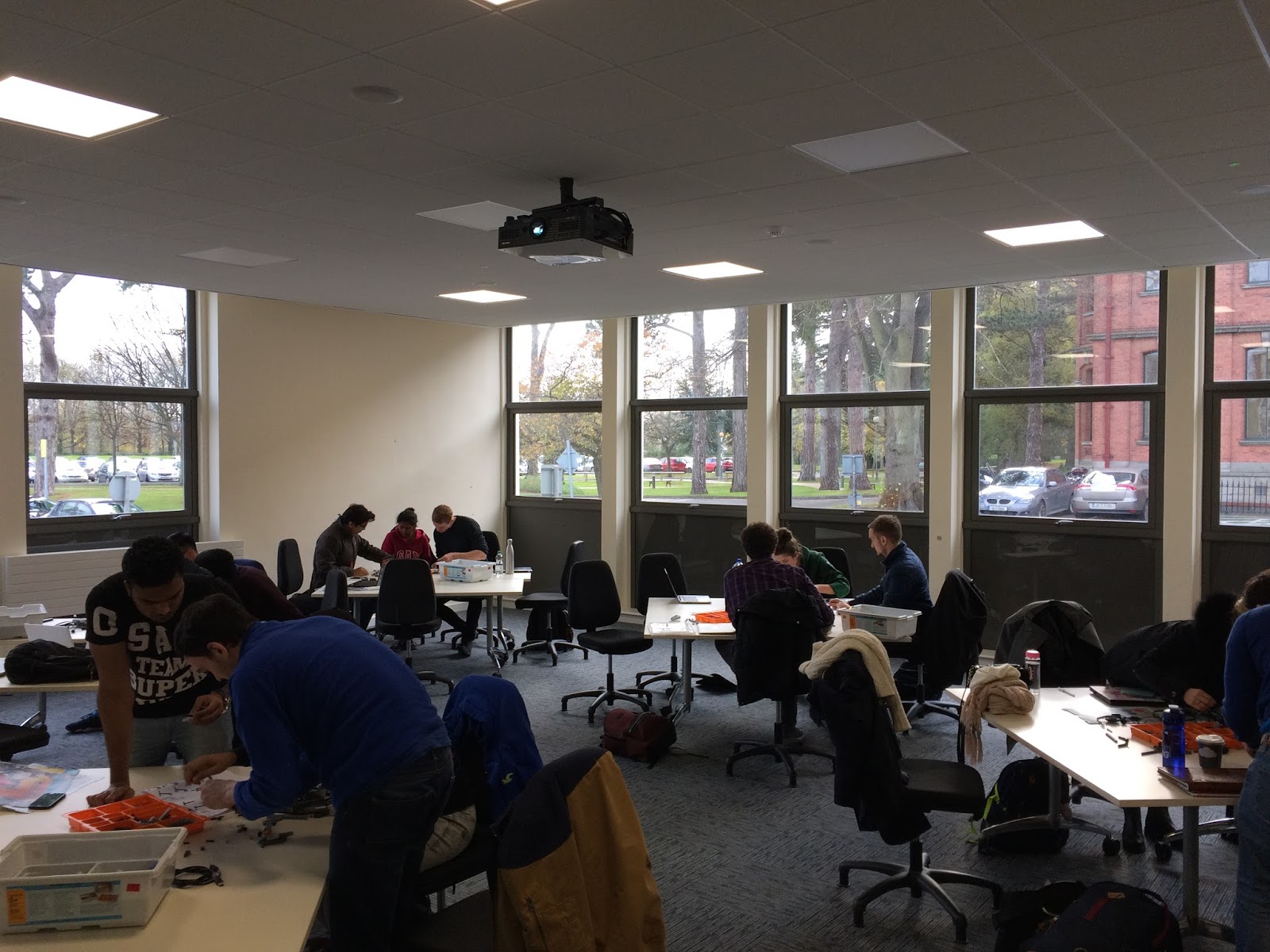


Guest lecture: MIS40920 BusInfo Systems Mgt (for ME/MEngSc programmes)
Q115 10-11am, April 4, 2018.
Research articles - discussion of the following articles.
Q: what do I know about...
...writing software?
...software engineering?
...working in teams?
Research articles - discussion of the following articles.
Both articles are readily accessible via the library's OneSearch function.
Establish an understanding of shared knowledge - Catmull, E. (2008). How pixar fosters collective creativity. Harvard Business Review, 89(9):9.
- Hargadon, A. B. and Bechky, B. A. (2006). When collections of creatives become creative collectives: A field study of problem solving at work. Organization Science, 17(4):484– 500.
Q: what do I know about...
...writing software?
...software engineering?
...working in teams?
 |
| Knowledge of engineering management concepts divulged in class |
 |
| A framing device for locating creativity along origin and time |
Tuesday, 20 February 2018
design mapping and idea tools
https://mural.co/
https://luma-institute.com/
https://www.invisionapp.com/
http://www.xplane.com/ (https://medium.com/the-xplane-collection)
http://gamestorming.com/
https://innovation-awards.nl/news/quick-guide-design-thinking/
https://medium.com/@harrybr/how-to-run-an-empathy-user-journey-mapping-workshop-813f3737067
Subscribe to:
Posts (Atom)