Design, Develop, Create

Monday, 21 October 2019

Agile at Guidewire videos

Agile Development at Guidewire. 

"What’s good about Agile is it makes process personal."
These videos convey something of the character of work in an Agile software development environment. Thinking in terms of practices, of 'practice theory' try identifying routinized bodily interaction, look at the way these people actively produce and interpret happenings to do with the focus of their work, how things like tools, screens, boards, scraps of paper, proximity, and conversations - occurring in distinctive locations - think about what it takes to know how to perform here, to know how performances matter, how involvement produces knowing.

Guidewire's video archive
Product management - identify the important practices...
https://www.youtube.com/watch?v=N0wVEqeEEI4

Testing is the foundation of any successful product
https://www.youtube.com/watch?v=-myDy3EcEDA

Agile implementation - different groups perceive different benefits, value/values
https://www.youtube.com/watch?v=CtJYCV_tZNk

The big internal shift within Guidewire - cultural, systems, workplace practices
https://www.youtube.com/watch?v=tQuTBp8L_ls

Is it necessary for support roles to work the same way? They say they do but do the?
https://www.youtube.com/watch?v=uZ5GG7v-dug

Big insurance companies will never do this...
https://www.youtube.com/watch?v=2Nj5IFpoaYc

A philosophy for everyone? - sales, customers, design, production alike?
https://www.youtube.com/watch?v=CaJUPJZ07Q0

And the perspective of customer organisations? Or the role for customers in development?
https://www.youtube.com/watch?v=Z46xJ1psqWw


Monday, 14 October 2019

Scholarly Search

Writing the literature review
A literature review is not a summary of "what you've learnt from what you've read". Rather, consider the challenge to be writing a 'problem oriented narrative'. A simple problem-oriented narrative has three parts. 
Beginning, middle, end.
Problem, framing literature, resolution. 
Identify an overall issue and gradually introduce scholarly works, develop an integrated framework, arrive at a clearly focused question.

Accessing academic literature
Search for related prior research that would inspire and inform your next steps. Select and refine relevant keywords for this search. The following databases index academic (peer-reviewed research) publications.

  • The DOAJ (Directory of Open Access Journals) (link) - a community-curated online directory that indexes and provides access to high quality, open access, peer-reviewed journals. 
  • Google Scholar* (link)
  • Scopus* (link)
  • Web of Science* (link)
  • Elsevier* - also hosts some open access journals (link)
  • SAGE Publishing* - also hosts some open access journals (link)
  • Springer* - also hosts some open access journals (link)
  • Routledge* - also hosts some open access journals (link)
  • JSTOR* - also hosts some open access journals (link)
  • Project MUSE* - a public index/catalogue (link)
* Search functions and file access to search results may be restricted to registered users or computers on campus networks.

If you find (potentially) interesting articles but cannot access them freely you should consider contacting the author(s) directly by email. Introduce yourself and reason for seeking access to a copy. Many authors will respond generously to such requests from students and share drafts or pre-press copies.

Another tack to take. Assuming that the article/chapter/section/publication sought is not the only relevant research dealing with this topic in the research world, you can conduct a forward citation search, that is, search for articles that cite this one. Searching forward ("cited by") approach is also a good way of the paper's impact and of identifying similar current research publications.

Writing - Reading Group

(a modified `writing - reading tutorial' protocol based on a description by Alexa Zellentin, of her experience running Oxford tutorials)

We read and discuss in turn a draft paper from each of a group of no more than three students.
  1. Reading out one’s work to others
  2. Author then quietly listens to others' discussion noting agreement/disagreement, comprehension etc.
  3. Each reader makes one (1) suggestion of how a might point may be made more clearly or forcefully.
Revision for next week to demonstrate visible progress in the development of the paper - with personal benefits for how interpret feedback; for how to make more nuanced and clearly expressed arguments.

Friday, 11 October 2019

Products/services are just a means...

The Delft Design Guide asserts that:
Products are just a means for accomplishing appropriate actions, interactions and relationships; products provide meaning for people only through interaction. (Buijs, 2012)
In essence, products and services don't exist for their own benefit, they are tools through which people achieve their goals by interacting with the products.


References and further reading:

Buijs, J. (2012). The Delft Innovation Method: a design thinker’s guide to innovation. Eleven International Publishing, The Hague.

Agile is dead - Dave Thomas (Pragmatic Dave) presentation.

Dave Thomas offers a timely call to turn back to the basic ideas and principles behind the Manifesto for Agile Software Development. Not "Agile" as such but courageous "agility". Strive to keep this attitude in mind!!

Thursday, 10 October 2019

The Digital Methods Initiative

https://wiki.digitalmethods.net/Dmi/ToolDatabase

The index of tools curated by The Digital Methods Initiative (DMI). The DMI is one of Europe's leading Internet Studies research groups. Comprised of new media researchers and PhD candidates, it designs methods and tools for repurposing online devices and platforms (such as Twitter, Facebook and Google) for research into social and political issues.

Monday, 7 October 2019

Requirements vs Specification

The distinction between the two, Requirements vs Specification, can be subtle at times.
Both may run the risk of containing incompatibilities and inconsistencies that need to be teased out through various means.
An to approach the challenge of making sense of requirements, and making requirements sensible is to create a compatibility matrix.

So as an exercise - assess the interdependencies and linkages (positive and negative) between the Good Friday Agreement (GFA) and the proposed replacement for 'backstop' previously agreed as part of the the UK-EU Withdrawal Agreement (WA).
The following requirements can be used for this exercise

  1. To protect the GFA the signatories require:
    1. There must be no hard border between Ireland and Northern Ireland
    2. Within a customs territory there can be no tariffs, quotas, or checks on rules of origin.
    3. The Common Travel Area arrangements between Ireland and the United Kingdom must remain.
    4. There must be a Single Electricity Energy Market on the island of Ireland.
    5. North-South cooperation and the all-island economy must be protected.
    6. Regulation will remained aligned to preserve the EU's Single Market and covering: legislation on goods, sanitary rules for veterinary controls (“SPS rules”), rules on agricultural production/marketing, VAT and excise in respect of goods, and state aid rules.
  2. To enable an independent UK Trade Policy on withdrawal from the EU HMG require:
    1. Border checks in and out of the territory of the UK.
    2. To restore the UK Supreme Court to the court of last resort for the UK (the highest judicial body within a jurisdiction).
    3. To apply UK's own customs tariffs for goods entering the UK market.
    4. To establish UK's own goods rules, legal compliance regulation and checks.
    5. To have UK Govt. only controlled internal goods market.
    6. To have UK Govt. only controlled services market.
    7. To have UK Govt. only controlled labour market.
    8. To have UK Govt. only controlled immigration policy (movement of people).
    9. To restore UK Govt. only controlled maritime resources.
    10. To apply UK's own independently determined Customs Tariffs.
    11. To enable UK's own approach to industry supports and subsidies (may be subject to WTO competition rules).
    12. To negotiate and establish UK's own trade deals with 3rd countries.
Partially completed feature requirements matrix for Brexit (+/- correlation, o=no or unknown effect)


WA - proposed protocol on Ireland/Northern Ireland
https://assets.publishing.service.gov.uk/government/uploads/system/uploads/attachment_data/file/836029/PM_letter_to_Juncker.pdf
... and a decoding of the letter
https://www.politico.eu/article/boris-johnson-big-brexit-offer-decoded-annotated/

The GFA (only 35 pages)
https://www.dfa.ie/media/dfa/alldfawebsitemedia/ourrolesandpolicies/northernireland/good-friday-agreement.pdf

European Commission notes on Brexit
https://ec.europa.eu/ireland/news/key-eu-policy-areas/brexit_en

Thursday, 3 October 2019

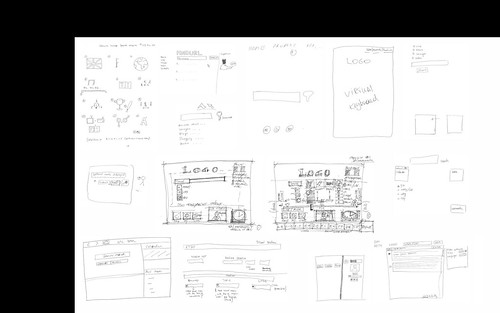
Exercise: (a) Design your ideal search page

This exercise familiarises students with interface design approaches and tools. The exercise is inspired by Carol Snyder's book titled "Paper Prototyping" (2003).

Objective
To practice creating design artifacts to display and test technology use/interaction ideas.

Material
Sheets of A4 paper, post-it notes, pens and pencils of different colours.

Instructions
1. In groups of 2 or 3 use paper/pencil sketch a mockup of a basic Internet ‘search page’. (allocate 10")
2. Collect the sketches and display them to the class; allow the group to provide a brief commentary. (allocate 10" to display all mockups).
3. In the same groups use Balsamiq to create a digital version of the design. The new design may vary from the paper/pencil sketch. (allocate 15")
4. Discuss the following reflection points (in groups first followed by class discussion). (allocate 10")

Reflection
Describe your feelings and thoughts on the process of translating your ideas into a concrete representation.
Comment on the discussion dynamics within the group.
How did the tool used shape, constrain or enable your design thinking?
Consider the difference between paper/pencil sketch vs Balsamiq.

References
Snyder, C. (2003) Paper Prototyping: The fast and easy way to design and refine user interfaces, San Francisco, CA, Morgan Kaufmann, Elsevier Science.


Student Examples

Whole class examples in collage:
designdiagrams01

Thursday, 26 September 2019

A brief history of computing technology

I believe, as innovation scholars, that we must acknowledge where our history, or starting points, rather than indulge in the unjustified belief that new ideas, that creative acts, begin with a blank canvas.

The three presentations below highlight the context and milestones in the history of computational technology:
  1. Timeline of Computing History (by The Computing History Museum link)
  2. Some Milestones in Computer Input Devices: An Informal Timeline (by Bill Buxton link)
  3. (A History of) Mobile Computing (by Jesper Kjeldskov link)
They help us to understand something of the history and context from which we begin. An understanding of our history forces us to acknowledge the resilience of certain ideas, concepts, aspirations, and observe the often selective couching of seemingly incontrovertible "facts" surrounding the design and development of technology. These beliefs are a subtext to the unfolding history of computing technologies. For example, the pace of technological centred development and innovation ever increasing (where in fact it is faddish and gyrates; transformational change creeps up on society before seemingly bursting onto the scene).  The resilience of various beliefs and assumptions held by managers, designers, users and others also demands scrutiny, for example: belief in the agency of technology; the presumed rational/irrational behaviour of users; appealing to the efficacy of management structures; the aspiration to acquire control knowledge; the oft stated belief that technology should “just work”.

But technology initiatives are also political actions, people creating value, new resources, contesting for new properties. Yet the creative spark that ignites the art of designing, developing and applying technology is elusive and unmanageable. Technology, innovation, organisation, society, knowledge; so many questions arise. What is management's role in motivating change? What is the impact of each wave of newer and ever better technology? How does innovation advance? Incrementally, slowly, abruptly, diffusing, drifting, adapting, evolving? What are the actual trajectories of innovation as it happens? We know fads and fashions come and go but society is in thrall with the 'new', the radical shift, that more often than not fails to acknowledge its own past or pedigree, its reliance upon older things, systems and ways of knowing the world.

Thursday, 19 September 2019

About our Academic Writing Centre

Writing Workshops

The UCD Michael Smurfit Graduate Business School Academic Writing Centre is run by Dr Megan McGurk. The UCD Academic Writing Centre in Belfield can be found at 
https://www.ucd.ie/writingcentre/

Academic Writing

Any topic you wish to write about has already received a significant amount of academic inquiry. Scholars communicate through citation as a method to trace how ideas develop through research. Learn the basics of argumentation, how to paraphrase research and how to cite your sources in the Harvard referencing format.

Persuasive Writing

Writers often labour under the misconception that if they just collect enough data they can persuade an audience. Yet people are rarely convinced by facts alone. We’ll investigate strategies to distinguish your writing from the default ‘officialese’ prose that dominates business practitioner style, but rarely inspires or encourages an audience to action. Persuasive writing incorporates stylish prose, an angle of vision, emphasis and storytelling.

Business & Report Writing

Business writing is transactional. People turn to writers who can help them to solve problems and make decisions. Practitioner style requires writers to be clear, concise and coherent when offering recommendations. We’ll cover report style, format and presentation.

Collaborative Writing

Group writing assignments can pose a major challenge for post-grads. Currently, more than 80% of writing produced by companies and organisations occurs through a collaborative effort. Learn effective strategies to balance and negotiate your team projects.

Be your own editor

First draft submissions will never garner top marks with lecturers, employers, clients or stakeholders. Develop a revision habit that allows you to benefit from building upon a tentative piece into a polished whole. Skilled writers do not leave projects to the last minute and they do not hesitate to delete and re-write. Learn how to identify problems at the sentence level in order to professionalise your writing.

Wednesday, 18 September 2019

Exercise: design and planning game


Goal

To demonstrate and experience one particular process of planning in a team environment where knowledge and expertise is distributed among team members.

Roles/Identities:
  • Product Owner: Product owner judges the trade-off between value and timing of features. Will engage in discussions at the PLANNING GAME, prioritising and valuing features. Is authoritative to accept a feature as developed or NOT.
  • Architect: Architect identifies links between features, architectural/design and delivery elements. Creates diagrams linking Features (F) with architectural elements (A) and deliverables (D).
  • Lead Developer and extra developers if available: Developers provide estimates of effort and risk for design-delivery elements. Have important domain knowledge and suggests needed features. Is authoritative on estimates for effort or time of a design-delivery element.
  • Scrum Master: Scrum master (or someone assigned) will turn feature and development stories into a planning chart and highlight the critical path.
Activities 
The Scum master keeps the PLANNING GAME focused by:
  • asking “what (F) features do we need?”
  • asking “what (D) deliverables satisfy (F)?”
  • asking “how does (A) architecture link (F) & (D)?”
Allocate approximately
Feature Discussion (5 minutes)
Design-delivery discussion (~5 minutes)
Architecture discussion (~5 minutes)
Decide backlog (~10 minutes)

Debriefing
~10’ Discussion: group pairs report progress to the whole class.
Was there a perfect solution?

Research and Further Reading

Thursday, 12 September 2019

Who was Winston Royce?

(from Wikipedia)
"Winston W. Royce (1929 – 1995) was an American computer scientist, director at Lockheed Software Technology Center in Austin, Texas, and one of the leaders in software development in the second half of the 20th century. He was the first who described the Waterfall model for software development, although Royce did not use the term "waterfall" in that article, nor advocated the waterfall model as a working methodology.
...
His son is Walker Royce, Chief Software Economist of IBM's Rational division, and author of "Software Project Management, A Unified Framework", and a principal contributor to the management philosophy inherent in the IBM Rational Unified Process."

Is it reasonable to interpret Royce in terms of agility? Emphasizing communication, design/coding as the central activity, responding to change, refactoring design, visibility, and on-site customers?

Walker Royce at IBM -  Walker's article on peoples' aspirations to become more agile (drdobbs.com)

How says software engineering doesn't have humour? Watch the Rise and Fall of Waterfall; with more than a touch of the truth (link).

Tuesday, 3 September 2019

Exercise: (c) Design for search by smell

(a collaboration with Norman Su) A variation on earlier design exercises (exercise a and exercise b)

Objective
Theory: To demonstrate the design dynamics surrounding paper sketches, digital sketches, and speculate on the implications for digital design environments.
Practice: To gain practice at creating sketches and digital design artifacts to display and test technology use/interaction ideas.

Materials
Sheets of A4 paper, post-it notes, pens and pencils of different colours.
Online access to the Balsamiq Mockups wireframing tool. http://webdemo.balsamiq.com/ (accessed: 2015-05-22. Also see http://balsamiq.com/products/mockups (accessed: 2010-2011)

Instructions Part 1
1. In groups of 2 or 3 use paper/pencil sketch a mockup of a new kind of App that uses 'scent' or 'smells'! (allocate 10")
2. Assume there is some way to capture 'scent' or 'smells'.
3. 10 minutes
4. Let me know (raise your hand, etc.) when you’re done

Instructions Part 2
5. In the same groups use Balsamiq to create a digital version of the design. The new design may vary from the paper/pencil sketch.
Tips:
Mockup → Download as PDF (to save a copy of your finished design)
Mockup → Clear Mockup (but don't mistakenly wipe your mockup before you save a copy)
6. 15 minutes
7. Let me know (raise your hand, etc.) when you’re done
8. Discuss the following reflection points (in groups first followed by class discussion). (allocate 5")

Reflection
Your own thoughts/observations?
How many design possibilities were sketched on paper? In Balsamiq?
Consider the difference between paper/pencil sketch vs Balsamiq.
How did the tool used shape, constrain or enable your design thinking?
Comment on the discussion dynamics within the group.
Did someone take responsibility for driving the group forward?
Describe your feelings and thoughts on the process of translating your ideas into different concrete representations.
Can you identify 'who contributed what' to the designs?

References
Digital nose teaches machines to smell - Turck duotec acquires a stake in SmartNanotubes Technologies (link)
The science of smell (link to article on brainfacts.org)
Intel Neuromorphic chip demonstrates smell functionality (article from intel.com)
"Sniffing Entrapped Humans with Sensor Arrays" (link) & NewAtlas article (link)Chat Perf for smartphone. Intro article on Gizmag (link)
SAPER app (link on gizmag). Not quite an electronic nose but close.
Wongchoosuk et al, (2009) Detection and Classification of Human Body Odor Using an Electronic Nose. Sensors, 9, 7234-7249. (doi 10.3390/s90907234 - resolve via dx.doi.org)
How Internet Odors Will Work (howstuffworks.com)
Related imagery and concepts on the Edible Geography blog (ediblegeography.com)
Want the nose of a Sommelier? (Null, 2018 - article on wired.com)

Monday, 13 May 2019

A typical day for software development (Silicon Republic article)

Jenny Darmody's article from Silicon Republic (2019: link)
"What does a software developer do on a typical day?" inside Verizon Media (http://www.verizonmedia.com/)

Tuesday, 23 April 2019

Seminars - Methods in Use and visiting MBA class

A open invitation to two seminars taking place this week; one today at 2pm (Tuesday 23 April) and tomorrow at (Wednesday 24 April).

The first invitation via Prof. Séamas Kelly (UCD)
===========================================
Dr Veeresh Thummadi (researcher at Lero | The Irish software research centre) will present a CITO seminar, Tuesday 23 April 2:00-3:30pm (room E117, Smurfit). The seminar will be entitled:
"Method-in-use variation during methodology use: A multiple case study of agile and waterfall information systems development projects”
An abstract for the talk and Dr Thummadi’s bio can be found at the end of the message..
===========================================
The second invitation from Prof. John Mooney (Pepperdine) who has specifically invited our MSc Digital Innovation class to take part in a short series of MBA seminars with visiting US MBA students from Pepperdine University's Graziadio School of Business.
===========================================
Wednesday 24 April 9:00-1:00pm (room N204, Smurfit)
* 9:00-9:45am Prof. Damien McLoughlin (UCD) on B2B and/or B2C marketing and customer service for the EEA market
* 10:00-11:15am Neil O'Herlihy (Director of Go To Market Operations at Google) is coming in to facilitate an interactive workshop on market strategies for EMEA.
* 11:45-1:00pm
Prof. Eamonn Walsh (UCD) presenting his excellent lecture on "tax havens" and the realities of the Irish tax situation for US MNCs.
===========================================
I hope you are able to take advantage of these sessions.

Wednesday, 3 April 2019

Wireframe and Mockup Tools

Wireframe and mockup tools for sketching designs.
Start with pencil and paper sketches before moving on to digital tools such as:
To use PowerApps go to Microsoft's Office software-as-a-service site and login with your @ucdconnect.com account which should already be provisioned via UCD.

https://www.office.com/

Monday, 1 April 2019

Study Trip to Brussels/Leuven 2019

Hi everyone

Welcome to the study trip. I look forward to meeting you all at the Irish College in Leuven (the Leuven Institute for Ireland in Europe -- known to all as the Irish College).
http://www.leuveninstitute.eu
See on Google Maps https://goo.gl/maps/GYrfDwsUhtK2

Plan to arrive and check-in to the Irish College, Leuven on Monday 18th March any time from 7am onwards.

Monday:

Our first session starts at 12.00 midday in the Irish College. Prof. Stijn Kelchtermans, from KU Leuven's Faculty of Economics & Business will be presenting on Technology Platforms.
https://feb.kuleuven.be/Stijn.Kelchtermans

The second session starts at 2.30pm also held in the Irish College. We'll be running a short workshop on Information Economics - the micro-economics of digital and information goods.

After this we will walk to the Health House showcase installation in Leuven for a tour at 5pm. The Health House showcases the future of health and care based on scientifically validated content and anticipating the impact that technology will have on this in future scenarios.
https://www.health-house.be/en/

Tuesday:

We start the day with a tour of the Living Tomorrow hub, a startup campus for innovative enterprises and where visitors can experience installations or imaginings of their products and services. The goal of Living Tomorrow is to help envisage, experiment and present how technology mediated changes may radically improve the quality of our future home, life and workplace.
https://www.livingtomorrow.com/en/about-living-tomorrow