"The blame is not for failure, it is for failing to help or ask for help"
 |
| Grant Freeland interviews Jørgen Vig Knudstorp (Boston Consulting Group video) |
|
| Grant Freeland interviews Jørgen Vig Knudstorp (Boston Consulting Group video) |

Group ID
|
Time (mins)
|
|---|---|
a
|
1 hr 13'
|
b
|
non-finish
|
Group ID
|
Time (mins)
|
|---|---|
a
|
24'
|
b
|
non-finish
|
c
|
29'
|
e
|
27'
|
f
|
non-finish
|
g
|
non-finish
|
h
|
non-finish
|
i
|
23'
|
j
|
non-finish
|
Group ID
|
Time (mins)
|
|---|---|
a
|
non-finish
|
b
|
non-finish
|
c
|
non-finish
|
e
|
20'
|
f
|
non-finish
|
g
|
'1'? non-finish
|
h
|
non-finish
|
i
|
31'
|
j
|
non-finish
|
| Group ID | Time (mins) |
|---|---|
| a | 20 |
| b | 35 |
| c | 40 |
| e | 29 |
| f | non-finish |
| g | 42 |
| h | 47 |
| i | 40 |
| j | 34 |
| Group ID | Time (mins) |
|---|---|
| 1 | non-finish |
| 2 | non-finish |
| 3 | 33 |
| 4 | 40 |
| 5 | 33 |
| 6 | 25 |
| 7 | 28 |
| 8 | 34 |
"Participants from all backgrounds gain key team building skills through collaborating closely at every stage of ideation, innovation, deployment, evaluation and scaling. At the end of the training teams are required to present their ideas and results, building effective communication skills." (Lewis, 2014)
"It's really hard to design products by focus groups. A lot of times, people don't know what they want until you show it to them." Steve Jobs, quoted in BusinessWeek (25 May 1998) cross ref. (link)THE USER AND REQUIREMENTS
If you have a product or if the product is still just a concept you must be able to answer the question: “what goal does the user attain by using your ‘offering’ or product?”INTRODUCTION
CASE: A vignette on the value of qualitative research (Cooper et al. 2007)
“In one particularly illustrative example, we were asked by a client to perform a user study for an entry-level consumer video-editing product for Windows users. An established developer of video editing and –authoring software, the client had used traditional market research techniques to identify a significant business opportunity in developing a product for people who owned a digital video camera and a computer but hadn’t connected the two yet.
In the field, we conducted interviews with a dozen users in the target market. Our first discovery was not surprising – that the people who did the most taping and had the strongest desire to share edited versions of their videos were parents. The second discovery, however, was quite startling. Of the 12 people whose homes we visited, only one person had successfully connected his video camera to his computer, and he had relied on the IT guy at work to set it up for him. One of the necessary preconditions of the success of the product was that people could actually get video onto their computers to edit, but at the time it was extremely difficult to get a FireWire or video capture card functioning properly on an Intel-based PC.
As a result of four days of research, we were able to help our client make a decision to put a hold on the product, which likely ended up saving them a considerable investment.” (Cooper et al., 2007)
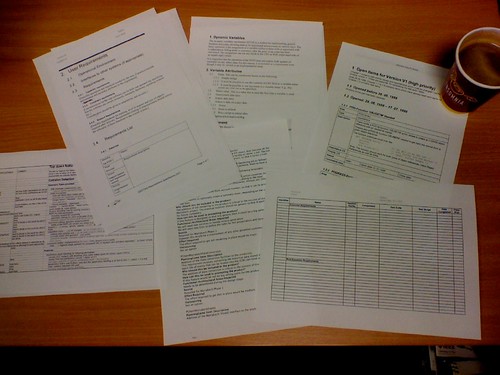 |
| A selection of typical requirements documents. |
5. "Scenario level"
4. "Requirement level"
3. "High level solution"
2. "Medium level solution"
1. "Low level solution"
0. "Key ideas (lightbulb moments)"
"#designing #designprocess #designcollaboration #softwaredesign #digitalinnovation #guindondesignchallenge #thinking-aloud #researchmethods"
Reflect on your graph. Can you relate your findings to Raccoon's Chaos Model?
“opportunistic decomposition is better suited to handle the ill-structuredness of design problems… top-down decomposition appears to be a special case for well-structured problems when the designer already knows the correct decomposition. .” (Guindon, 1990)

Focus on the article being reviewed, not so much on other readings, books, articles etc.
Please do identify key quotes from the article. These a short statements or at most a sentence or two that distil some essential aspect of the article. A key quote is used: to point to the authors' evidence or claims; to make a justification for your own arguments; to act as a foundation for your own ideas. However, there must be clear delineation between the authors' content and your use of it.
Please use double quotation marks and page number to identify "the quoted text" p. 23. You could apply one of the standard citation methods if you like e.g. Harvard style:
4/5 people per group max
#1. Find words. Individual activity – 7” quiet, write notes.
#2. Share. Connect, cluster, name, move, organize, link
This happens on a shared wall/whiteboard
#3. Assign champions.
#4. 10”/round. Others move around over three rounds. Champion gives each a voice. Champion facilitates a conversation. Champion helps scribe.
First move; second move; third move.
#5a. 3” Champion synthesis. Devise a single key discovery and debrief to the wider group.
#5b. Alternate synthesis. 30" arrange a coffee break for the participants and the champions to come together to harness the materials that were gathered during the group rounds. Create a distillation/synthesis by drawing, sketching, writing, and/or typing up, a sense-making dialogue or cartoon or flow diagram or combination of all, to present by way of debriefing to the wider group. Will you ask them to create a combined synthesis or separate?
"The core mission of TechArchives is to create and preserve the stories surrounding Ireland’s long and convoluted relationship with information technology.
“What I think about the task-board, and I feel it myself, is that the engineers have a hell of a lot more autonomy now. In what they do, there is much less control about what we do now, we pick things off the board, ourselves and we drive them ourselves right through to the end”To start off we adopted the following guidelines influenced by one of Dublin's early Extreme Programming consultancy groups EXoftware - now part of emergn. The guidelines helped us start to get into the habit of having a daily stand-up and to avoid some of the weeds that inevitably sprout up around new organisational practices when they appear to start succeeding. The 'weeds' are things that others try to piggyback, slipstream, coat-tail onto anything that succeeds in getting people in one place and paying attention.

| Research Method | Description |
|---|---|
| Activity Analysis | A description of project relevant dynamics: actions, interactions, tasks, and objects of achieving goals. |
| Affinity Diagrams | Represent or diagram clustering of design elements with activities, goals, obstacles. Proximity, dependence and relationships |
| Anthropometric Analysis | Human factors or ergonomics to assess project relevant use factors. |
| Character Profiles | Personas. Archetypes of real people with real goals, lifestyle, behaviour, identities. |
| Cognitive Task Analysis | List, summary of all available sensory inputs decision points and actions. |
| Competitive Product Survey | Collect, compare, and conduct evaluations of extant and competitive products. |
| Cross-Cultural Comparisons | Personal accounts of differences in situations, behaviour and artefacts in different national or cultural settings. |
| Error Analysis | Capturing the things that actually go wrong in the project relevant setting. |
| Flow Analysis | The flow of information in existing and/or new system. |
| Historical Analysis | Identify trends and cycles of product use, customer behaviour, market, and practice. Relate to timeless goals |
| Long-Range Forecasts | Narratives of future scenarios complete with social and technological trends to predict behaviours. |
| Secondary Research | Summary analysis of existing sources and 3rd party data on project relevant areas. |
| Research Method | Description |
|---|---|
| A Day in the Life | Catalogue a person’s whole day without necessarily focusing on project relevant aspects. |
| Behavioural Archaeology | Look at use, wear, the detailed arrangement or organisation of use objects in their use setting. |
| Behavioural Mapping | Map position, movement, and use of space over time. |
| Fly on the Wall | Observe in context without interfering. |
| Guided Tours | Ask the user to guide you through project relevant spaces and activities. |
| Personal Inventory | Ask the user to reflect on and describe the things they view as important or significant |
| Rapid Ethnography | Participate and experience it first-hand with the user for as long as possible. |
| Shadowing | Tag-along with people through the day. |
| Social Network Mapping | Notice the relationships between people, groups. Look for identity, profession, culture, and connections. |
| Still Photo Survey | Build up a visual record of key use and interaction moments over time. |
| Time-Lapse Video | A way of summarising activity over time, use of time, space, and location. |
| Research Method | Description |
|---|---|
| Camera Journal | A written and visual diary of project relevant circumstances and activities. |
| Card Sort | Organise cards spatially in ways that make sense. To expose mental models of device or system. |
| Cognitive Maps | Create a map of an existing or virtual space. The pathways they know and navigate, mental models. |
| Collage | Self created collage of arranged images. Used to help verbalise complex or unvocalised themes. |
| Conceptual Landscape | Sketch and juxtapose social and behavioural constructs from participants. People’s mental model. |
| Cultural Probes | A visual journal for participants to build up themselves. A self generated reflection. Gathered and compared across many participants. |
| Draw the Experience | Ask participants to visualise and draw the experience in their own way, with their own associations, order, relationships, theories. |
| Extreme User Interviews | Evaluate (ask) users at extreme ends of market (early adopters, power users, beginners) to highlight their issues. |
| Five Whys? | Ask “why?” in response to five consecutive answers. Expose/uncover deeper attitudes perceptions. |
| Foreign Correspondents | Elicit inputs from others (snowball sample) to build up varied cultural and environmental contexts. |
| Narration | Users perform tasks and achieve goals while describing aloud. Talk aloud protocol. Stream of consciousness. |
| Surveys & Questionnaires | Targeted questions to assess design, usage, interaction characterises and perceptions of users. |
| Unfocus Group | Gather a range of tools or materials and get diverse user group to create things relevant to the design or project. |
| Word-Concept Association | Users associate words with design. Cluster user perceptions to evaluate design features & concepts. Value and priority. |
| Research Method | Description |
|---|---|
| Behaviour Sampling | Snapshot people’s activities at different times. How do pervasive products intrude in your lives? |
| Be Your Customer | What is it like to purchase your product? Actual experience of searching, buying, consuming, disposing. |
| Bodystorming | Act out scenarios with many people, using space, place, sequence, queues, etc. Test performance in context. |
| Empathy Tools | Experience the range of users capability for involvement under real conditions. |
| Experience Prototype | Mock up a rough but workable prototype to simulate the experience of using the new product. |
| Informance | Act out scenarios observed in the field to interpret and analyse in the lab. Builds shared understanding and good for solution formation. |
| Paper Prototyping | Rapid paper based mock-ups that are manipulated to demonstrate functionality. To articulate design concepts with users. |
| Predict Next Year’s Headlines | Involve users in future design possibilities. Futuristic, wishing, unmet needs. Help separate what is needed now from what can wait. |
| Quick-and-Dirty Prototyping | Assemble a very rough mock-up of a new feature or product to help start and refine a design. |
| Role-Playing | Identify actors/stakeholders involved in design use, enact real activities in real or imagined context. |
| Scale Modelling | Simulation technique to test arrangements of space, place, context. |
| Scenarios | A character-rich story, to communicate (simulate) and test a plausible story in probable context. |
| Scenario Testing | Show depictions of possible future scenarios. Share reactions, refine concepts. |
| Try it Yourself | Like Microsoft’s famous ‘eating our own dog food’ being the first user. |
 |
| Survey population-sample size calculators |
Essay: Purely theoretical, elaborating a conjecture, speculation, conceptual, philosophical argumentation, thought experiment, word games, word play, rhetoric, logicism, formalism, constructionism.(partially derived from the Wikipedia article on Research Design):
Review, meta-analysis of prior research, selective literature review, systematic literature review.
Empirical: descriptive, idiosyncratic, case-study, naturalistic observation, questionnaire survey.
Correlational-causal: studies adopting systems model views, inputs factors, outcomes, case-control study, observational study, survey, structural equation modelling.
Statistical meta-analytic: research derived from other research, findings based on aggregations of other research.
Semi-experimental: research styled on intervention in settings, field experimentation not amenable to laboratory control, quasi-experiment, trials, living labs.
Experimental: classical closed system model of scientific discovery, reproducible experiment, blind experimentation, random assignment experiments.
The HICSS conference style in LaTeX is provided/shared via Overleaf. Overleaf is an online writing/editing service that uses LaTeX, the defacto standard for most scientific research writing...